1956 Gustave Baumann Rain in the Mountains Print
GUEST: My father, uh, bought this sometime in the, I think it was the early to mid-'70s. I was, like, ten. My dad bought this from Gustave Baumann's widow when she had come to Colorado State University. She was selling some of his work to raise money, selling from the estate. And this one always stopped him.
APPRAISER: Yeah, yeah, not hard to see why.
GUEST: (chuckles) No, it's...
APPRAISER: These colors are beautiful.
GUEST: It's... Yeah, it's just... It says everything about the West, uh...
APPRAISER: Sure.
GUEST: And so he bought it for, like, $125.
APPRAISER: The artist is Gustave Baumann, you know that.
GUEST: Yes.
APPRAISER: He was actually born in Germany and came over to the States as a child with his family, and was living in the Midwest.
GUEST: Uh-huh. Midwest, okay.
APPRAISER: He trained in Chicago and worked in Indiana, and it wasn't until about 1918 that he made his way down to New Mexico. He was intending to go to Taos. He got to Taos and he thought it was too busy.
GUEST: (laughs) Okay.
APPRAISER: So a friend persuaded him to move on to Santa Fe. So he gets to Santa Fe and basically plants himself there, and works in Santa Fe for the next five-plus decades. And his imagery have become synonymous with the Southwest. He and the Southwest are so intertwined, and New Mexico, and this feel...
GUEST: Yeah.
APPRAISER: ...of, of the Southwest. The feel of... It's...
GUEST: The light, he got the light just right.
APPRAISER: The light through those colors is amazing.
GUEST: I know.
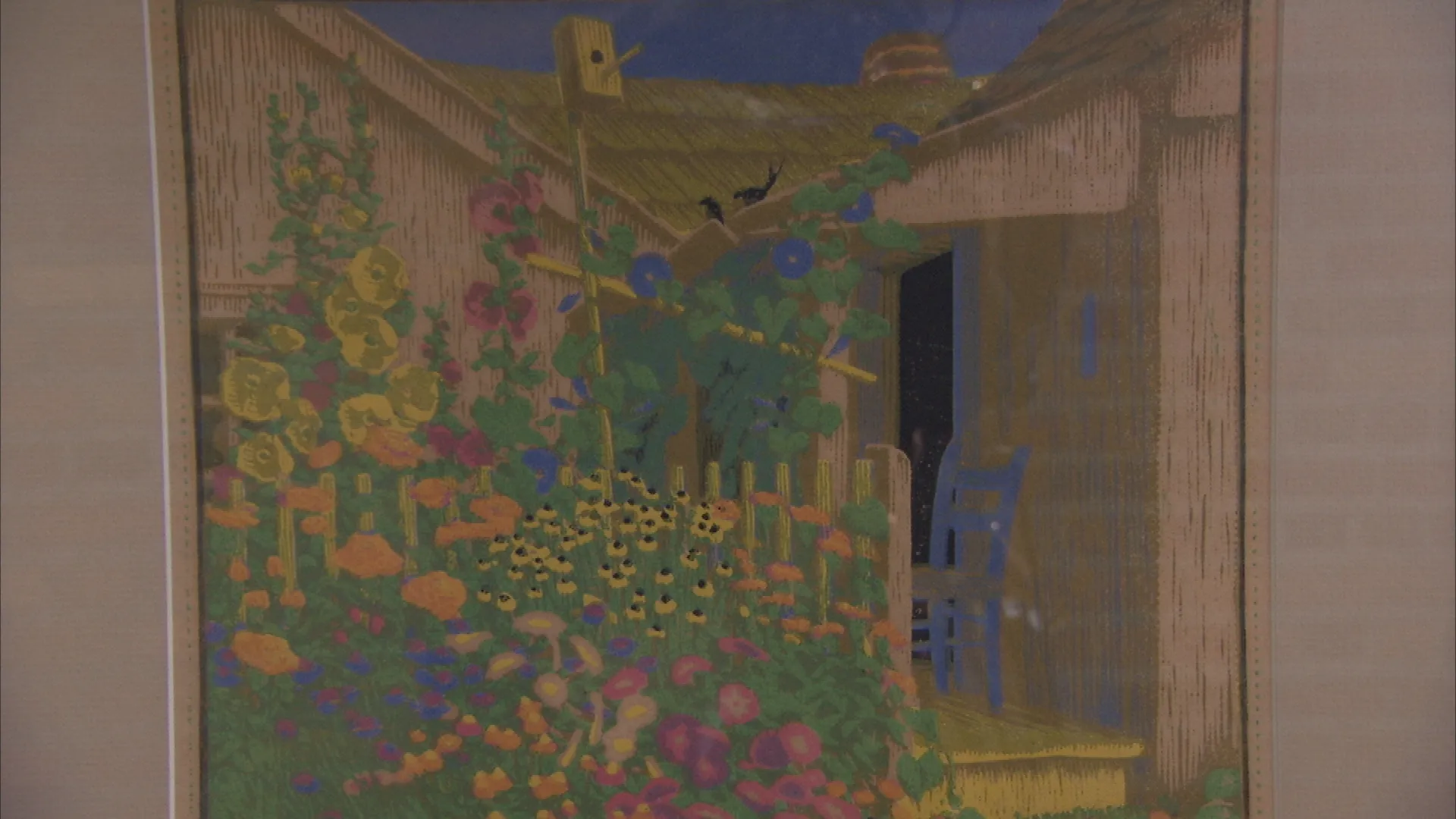
APPRAISER: And the appreciation for his work has just grown over the past couple of decades, and he is super-hot now. Baumann made the original blocks for this color woodcut in 1926, which is just about eight years after he arrived in Santa Fe. And this, you can see, of course, is titled Rain in the Mountains. This is from the fourth edition. He printed four editions of this subject over a 30-year period, starting in 1926, and completing with this fourth and final edition in 1956. The fourth edition is from an intended edition of 50. That's why it's numbered 19 of 50. And the "R-C" next to that numbering means the blocks were recut, reshaped by him...
GUEST: Oh.
APPRAISER: ...to produce this fourth edition.
GUEST: Uh-huh.
APPRAISER: This is the smallest edition, but there are all these intense colors.
GUEST: Yeah.
APPRAISER: And what's great about this, too, is the way that the rain is coming down.
GUEST: Yeah.
APPRAISER: In strips from... That, that's just such a great talent, to be able to pull that off by cutting a wood block. And then he mixed all the colors himself, signed it in pencil, titled it, and then this is his hand in heart ink stamp, which he used on his color woodcuts, just his sort of monogram symbol.
GUEST: Uh-huh.
APPRAISER: The appreciation for these...
GUEST: Uh-huh.
APPRAISER: ...like I said, the past couple of decades, has just increased exponentially.
GUEST: (laughing): Okay, now I'm really nervous.
APPRAISER: Would you have... Any guess as to what its value is?
GUEST: Well... Like... I, I, I guessed that, 'cause I know he's popular, but I thought ten times what my dad bought. So, $1,250 or something, $2,000, something like that.
APPRAISER: So you're in the thousands. This is a great image.
GUEST: Uh-huh.
APPRAISER: It's, it's... The more evocative you get with his imagery of the Southwest, the better. It's also one of the larger color woodcuts.
GUEST: Uh-huh.
APPRAISER: So it's got everything going for it. The colors are also perfect, like the day they were printed. It's, that's tough to find. I would put a replacement value or insurance value on this...
GUEST: Uh-huh.
APPRAISER: ...at $50,000.
GUEST: (gasping): Oh, my God! That is so much more than I thought. I think it was. Oh, that is so much more than I thought.
APPRAISER: Yeah, it's, it's a phenomenal print.
GUEST: Okay, I, um... I, okay, I'm, I'm going to have to do something about that.
APPRAISER: Yeah. It's just a beautiful image.
GUEST: Oh, thank you.
APPRAISER: Thank you so much for bringing it in.
GUEST: I, I, thank you for letting me know. That's really amazing. (laughing) Really, really amazing.
APPRAISER: (chuckling): It's an amazing image.
GUEST: Yeah, thank you.
APPRAISER: Yeah.
GUEST: It's always been of value to me, and now I'm going to go to an insurance agent and make sure that I've got it covered.
APPRAISER: Yeah. This one, this one sums up Baumann so well.
GUEST: Yeah. (both laughing) I feel like I'm having trouble breathing a little bit. Oh, my God, you're kidding.
APPRAISER: (laughing): No.
GUEST: I mean, really?
(both laughing)

$50,000 Insurance
Featured In
episode
Filoli, Hour 1
Kick off Season 27 with fascinating Filoli finds including a treasure of up to $330,000!
appraisal
Gustave Baumann Print, ca. 1927

appraisal
George Baxter Prints, ca. 1840
appraisal
Mark Catesby "Wood Stork" Print, ca. 1735
appraisal
"View of Des Moines" Print, ca. 1856
Understanding Our Appraisals
Executive producer Marsha Bemko shares her tips for getting the most out of ANTIQUES ROADSHOW.
Value can change: The value of an item is dependent upon many things, including the condition of the object itself, trends in the market for that kind of object, and the location where the item will be sold. These are just some of the reasons why the answer to the question "What's it worth?" is so often "It depends."
Note the date: Take note of the date the appraisal was recorded. This information appears in the upper left corner of the page, with the label "Appraised On." Values change over time according to market forces, so the current value of the item could be higher, lower, or the same as when our expert first appraised it.
Context is key: Listen carefully. Most of our experts will give appraisal values in context. For example, you'll often hear them say what an item is worth "at auction," or "retail," or "for insurance purposes" (replacement value). Retail prices are different from wholesale prices. Often an auctioneer will talk about what she knows best: the auction market. A shop owner will usually talk about what he knows best: the retail price he'd place on the object in his shop. And though there are no hard and fast rules, an object's auction price can often be half its retail value; yet for other objects, an auction price could be higher than retail. As a rule, however, retail and insurance/replacement values are about the same.
Verbal approximations: The values given by the experts on ANTIQUES ROADSHOW are considered "verbal approximations of value." Technically, an "appraisal" is a legal document, generally for insurance purposes, written by a qualified expert and paid for by the owner of the item. An appraisal usually involves an extensive amount of research to establish authenticity, provenance, composition, method of construction, and other important attributes of a particular object.
Opinion of value: As with all appraisals, the verbal approximations of value given at ROADSHOW events are our experts' opinions formed from their knowledge of antiques and collectibles, market trends, and other factors. Although our valuations are based on research and experience, opinions can, and sometimes do, vary among experts.
Appraiser affiliations: Finally, the affiliation of the appraiser may have changed since the appraisal was recorded. To see current contact information for an appraiser in the ROADSHOW Archive, click on the link below the appraiser's picture. Our Appraiser Index also contains a complete list of active ROADSHOW appraisers and their contact details and biographies.


