GUEST: When I was in college, one of my favorite professors, my philosophy professor, Ron, became one of our closest friends. And we've been friends now 30 years. He and his wife don't have their own kids, so they've always taken a special interest in my son, who is a huge baseball fan. And when he was eight or nine years old, they noticed he was collecting baseball cards. So they said, "Hey, we've got some baseball cards." These were cards that Ron collected when he was a little boy. I didn't know a lot about them. There were several hundred. And I sort of flipped through and found the ones that I recognized as being influential or important players.
APPRAISER: Well, let's go over your picks. And I think you did okay.
GUEST: Okay.
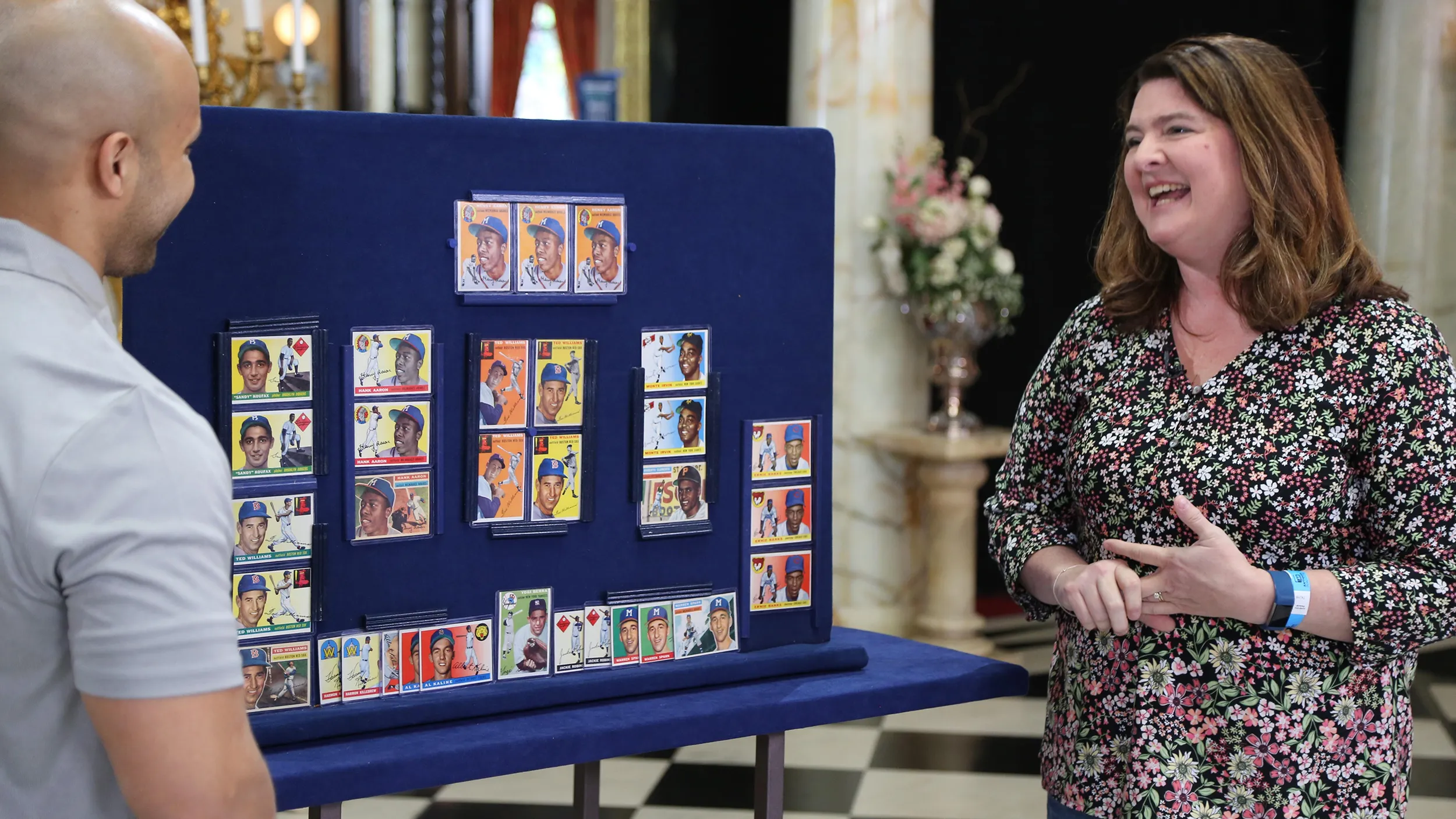
APPRAISER: So what you've got, essentially, is many of the 1950s Hall of Famers. You've got Sandy Koufax, Ted Williams, and, again, you've got quite a few Ted Williamses. You got Harmon Killebrew. Al Kaline, Yogi Berra, Jackie Robinson, Warren Spahn. You've got Ernie Banks, closer to you. Roberto Clemente, Monte Irvin, over here. Of course, Hank Aaron. More Ted Williams.
GUEST: (laughing) A particular...
APPRAISER: More Hank Aaron. You are missing arguably one of the most important cards in the Mickey Mantle.
GUEST: Oh, I know. When these arrived in the mail, I called my dad, because my dad was a huge baseball fan. And he said, "Stop what you're doing. Is there any Mickey Mantle card in there?" And so that was the first thing I looked for, and we didn't have any Mickey Mantles.
APPRAISER: That was the first thing I looked for.
GUEST: (laughing)
APPRAISER: These are all Topps cards from 1954 to 1956. And this is an era when they were called the Topps Chewing Gum Company. Now they're popularly known as Topps. So within your collection, you've got the Sandy Koufax rookie, you've got two of them. Did you know any of this information when you were picking them?
GUEST: I tried to make educated guesses. I looked on the back of the card, and if they only had one year of data represented, I figured that must be their rookie card. But it was truly a guess.
APPRAISER: A lot of these cards do have just one year, but it's a prior year.
GUEST: Oh.
APPRAISER: So it wasn't necessarily their first year. It was their most recent performance, okay?
GUEST: I see.
APPRAISER: Ted Williams is a great example. This is now toward the end of his career.
GUEST: Right.
APPRAISER: In '56. That was not his rookie card.
GUEST: Uh-huh, got it.
APPRAISER: You do have some rookie cards. Do you happen to know which ones they are?
GUEST: I think we figured out, maybe this is Hank Aaron's rookie card, but that's a guess.
APPRAISER: Bingo. Hank Aaron, Sandy Koufax. So good work, okay?
GUEST: Yay!
APPRAISER: Condition is everything with baseball cards. For example, you look at the corners of the cards.
GUEST: Okay.
APPRAISER: You look at the even spacing of the lines, and generally, whether there's any paper loss, any foxing and discoloration.
GUEST: Okay.
APPRAISER: Card creators are going to hate hearing me say this, but they're finicky people.
GUEST: (laughs)
GUEST: And on a scale of one to ten, ten being pristine and undamaged in every respect, you've got about an average of twos, and that affects value.
GUEST: Okay.
APPRAISER: Of course, the tens, that's what you read about.
GUEST: Yeah, right.
APPRAISER: That's retirement money.
GUEST: Yeah, right.
APPRAISER: But you've got twos.
GUEST Okay.
APPRAISER: At auction, these that we selected-- you have more, but we selected
just these-- are worth $3,000 to $5,000.
GUEST: Oh, wow, that's awesome!
APPRAISER: Okay? These three in particular, Hank Aaron's rookie cards... Yeah. ...can each sell in this condition for around $800.
GUEST: Okay, that's good to know.
APPRAISER: Okay?
GUEST: Awesome-- thanks!
APPRAISER: That Clemente card, in perfect condition, is a $15,000 card.
GUEST: Oh, wow.
APPRAISER: If it's a perfect card.
GUEST: I see.