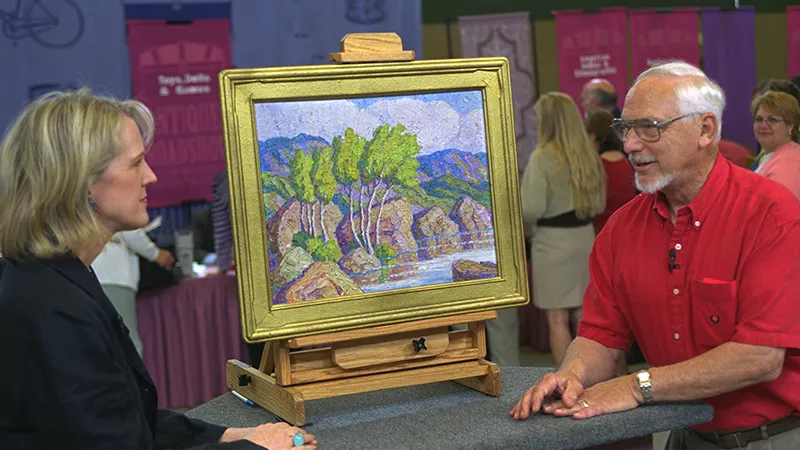
GUEST: In 1946, Birger Sandzén, the artist here, started a little summer art session, and I was one of the lucky few that got into that. And I remember doing the standard drawings, and Sandzén would come through once in a while. And the painting that I was doing was of a donkey. And he looked at it and he said, "More paint." And that was basically his idea was to put more paint on anything you painted.
APPRAISER: Well, that's certainly very apropos, given the surface of this painting. Sandzén, as I'm sure you know, was born in Sweden and moved to Lindsborg, Kansas, in 1894 to teach at Bethany College. And like other artists in the region, like Thomas Hart Benton and Grant Wood, Midwestern artists, he was aware of more avant garde movements like cubism or futurism and modern trends like abstraction. But he really preferred to paint a realistic view of the American landscape because he felt that that's what people could really relate to.
GUEST: Right.
APPRAISER: And he had a unique style of painting where he left a very thick layer of impasto over the entire surface. After he visited Colorado, he brightened up his colors and his whole palette became lighter and brighter. And this is actually a Colorado work.
GUEST: Yes.
APPRAISER: It's signed and dated 1937 in the lower right, and it's also signed and titled on the reverse, "Mountain Stream, Big Thompson Canyon in Estes Park."
GUEST: Right.
APPRAISER: His market didn't really take off until the '80s and '90s. He was really pretty much unrecognized in the American marketplace. And because of his unusual technique of painting, he was sort of nicknamed the American Van Gogh, but the artist always disclaimed any great influence of Van Gogh.
GUEST: Uh-huh.
APPRAISER: I think at auction, this might bring as much as $30,000 to $50,000.
GUEST: Oops! (chuckling) Oops. Uh... No, I was thinking in the hundreds, maybe, but thousands, no.