1936 Lou Gehrig Autograph


GUEST: I have a postcard that belonged to my husband's grandfather, and it is the autograph of Lou Gehrig.
APPRAISER: And what could you remember about receiving the postcard?
GUEST: It was in a scrapbook that his grandmother gave us, and you can see there's kind of glue marks on there. And I knew immediately I had to get it out of the paper because it had acid in the paper.
APPRAISER: So looking at this side of the postcard, we see the glue residue, and then we also see the postmark there.
GUEST: Right.
APPRAISER: From St. Petersburg, Florida, March 20, 1936.
GUEST: Yes.
APPRAISER: Let's take a look now at the signature. So first thing is, it is authentic.
GUEST: Okay.
APPRAISER: There's so many different factors in collecting autographs now. The collectors have insisted on not only authenticity, but also provenance. And with every autograph, there's a story. And what was great about the postcard is it tells us that this was mailed from spring training for the New York Yankees in 1936. Then there's the condition. The condition is excellent. It's a graphite signature that's really strong.
GUEST: Good.
APPRAISER: Then we look at Lou Gehrig in 1936. He was in the prime of his career. He was the league MVP, they won the World Series, he made the all-star team for the fourth straight year, he led the league in home runs with 49, with runs scored with 167. It was absolutely one of his best seasons of his career. Why this is important is because there's different levels of signatures. We have players who sign during their career. There's players who sign their whole lives. There's also signatures from players from an offseason. There's all those different factors that factor in. What's so great about this example is that 1936, being the prime of his career, makes it about as good as they get for a Gehrig signature. The other thing that I like is how you've taken the time to frame it, exposing the back. Anything else you know about Lou Gehrig?
GUEST: Of course Lou Gehrig's disease, ALS. Everybody associates that with him.
APPRAISER: Which he was diagnosed on June 19, 1939, on his birthday. Well, as we talked about it, great example from a great season in his career. So we would put an estimate on this, a retail value of $10,000.
(laughs)
GUEST: I'm stunned. I thought maybe $800 would be lucky. $10,000?
APPRAISER: Yup.

$10,000 Retail
Photos

Featured In

episode
Little Rock, Hour 1 (2016)
An Olin Travis oil, a Lou Gehrig autograph, and an English cabinet-on-stand!
Memorabilia

appraisal
20th-Century Presidential Autographs
appraisal
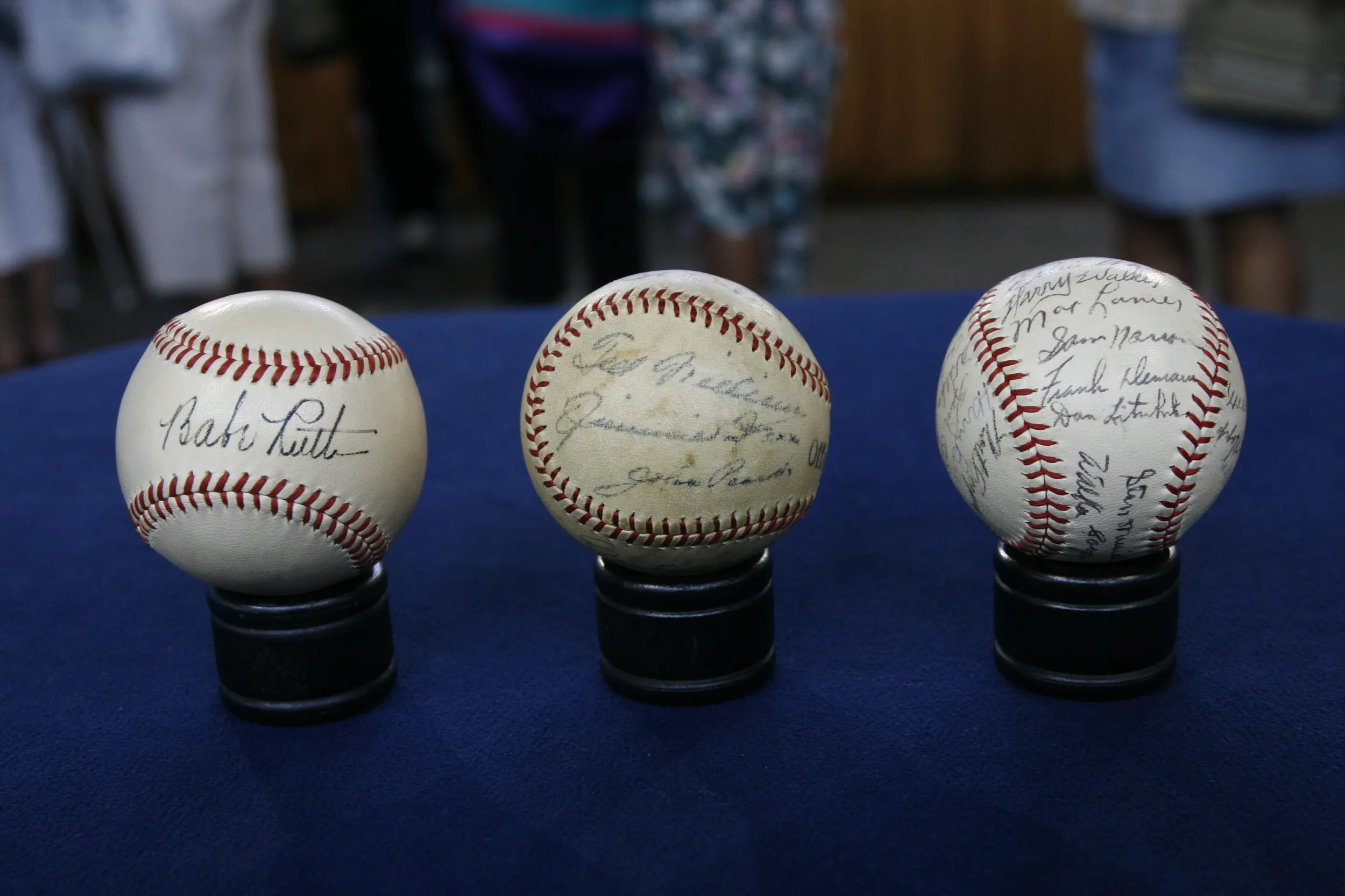
Three 1940s Signed Baseballs

appraisal
1935 Signed "Porgy & Bess" Book

appraisal
1957 Buddy Holly Contract
Understanding Our Appraisals
Executive producer Marsha Bemko shares her tips for getting the most out of ANTIQUES ROADSHOW.
Value can change: The value of an item is dependent upon many things, including the condition of the object itself, trends in the market for that kind of object, and the location where the item will be sold. These are just some of the reasons why the answer to the question "What's it worth?" is so often "It depends."
Note the date: Take note of the date the appraisal was recorded. This information appears in the upper left corner of the page, with the label "Appraised On." Values change over time according to market forces, so the current value of the item could be higher, lower, or the same as when our expert first appraised it.
Context is key: Listen carefully. Most of our experts will give appraisal values in context. For example, you'll often hear them say what an item is worth "at auction," or "retail," or "for insurance purposes" (replacement value). Retail prices are different from wholesale prices. Often an auctioneer will talk about what she knows best: the auction market. A shop owner will usually talk about what he knows best: the retail price he'd place on the object in his shop. And though there are no hard and fast rules, an object's auction price can often be half its retail value; yet for other objects, an auction price could be higher than retail. As a rule, however, retail and insurance/replacement values are about the same.
Verbal approximations: The values given by the experts on ANTIQUES ROADSHOW are considered "verbal approximations of value." Technically, an "appraisal" is a legal document, generally for insurance purposes, written by a qualified expert and paid for by the owner of the item. An appraisal usually involves an extensive amount of research to establish authenticity, provenance, composition, method of construction, and other important attributes of a particular object.
Opinion of value: As with all appraisals, the verbal approximations of value given at ROADSHOW events are our experts' opinions formed from their knowledge of antiques and collectibles, market trends, and other factors. Although our valuations are based on research and experience, opinions can, and sometimes do, vary among experts.
Appraiser affiliations: Finally, the affiliation of the appraiser may have changed since the appraisal was recorded. To see current contact information for an appraiser in the ROADSHOW Archive, click on the link below the appraiser's picture. Our Appraiser Index also contains a complete list of active ROADSHOW appraisers and their contact details and biographies.


