1935 S.S. Normandie Art Deco Chrome Vases
GUEST: These are two vases that my father-in-law gave to me. He said his mom got them in the '40s in Queens, and that she was told that they were pulled from the Normandie. But that's all that I know.
APPRAISER: Okay. And, um, what would you like to know about them today?
GUEST: Honestly, I just want to know anything about them, because I'm a giant ANTIQUES ROADSHOW fan girl and I'm just so excited to be here. So just to know anything, really, at all.
APPRAISER: These were in fact designed for the S.S. Normandie. The S.S. Normandie was brought into service in 1935.
GUEST: Mm-hmm.
APPRAISER: And at the time it was the fastest ship to cross the Atlantic. It was fitted out on the interior by many designers, but including Georges Bastard and Edgar Brandt, both notable designers of the time. These are a pair of nickel-plated chrome vases. They measure approximately 13 inches tall and there were two sizes that were fitted out in the ship. There was the smaller versions and these large 13-inch examples. At the beginning of the 1940s, the S.S. Normandie was actually seized by the American government to be converted into a troop ship and at that time, it was decommissioned in New York City and the interiors were completely pulled out. They took out all the furniture, decorative arts, lighting, and accessories. In 1942, there was a fire on the ship, and then it actually sank. There are a lot of pieces that came off the ship that still exist today. On this wonderful pair of vases, they're actually signed. First of all, in the middle we have the monogram of the French company, which was a private public conglomerate that was the owner of the ship, which is Compagnie Générale Transatlantique.
GUEST : Okay.
APPRAISER: And then they're also signed. Lower left is Georges Bastard and then lower right is Edgar Brandt. It was a great collaboration. So when we look at these two, one of them is just ever so slightly unstable. They are just bolted up through the bottom and it's likely a thread that just tightens up just a little bit.
GUEST: Oh, okay.
APPRAISER: These are really in very good shape. Because there was a lot of them made-- and by a lot, I don't mean hundreds, but dozens of pairs—
GUEST: Yeah.
APPRAISER: We have really good sales records for them. If I were to see these come up for auction in today's market, I would expect to see a value of $8,000 to $12,000.
GUEST: Wow! (laughs) That's so exciting. Just to hear you say that, (laughing): I'm like, "I'm really on ANTIQUES ROADSHOW!" That's so awesome.
APPRAISER: I'd recommend an insurance value of around $20,000.
GUEST: Wow, okay. Good to know.

$8,000 Auction
$20,000 Insurance
Featured In

episode
Georgia State Railroad Museum, Hour 2
Premiered Mon, Feb 2, 2026 — All aboard as ROADSHOW travels to Savannah, Georgia, in search of America’s hidden treasures.
Vase

appraisal
Dirk Van Erp Copper Vase, ca. 1930

appraisal
Venetian Glass Vase, ca. 1935

appraisal
1900 Della Robbia Vase
appraisal
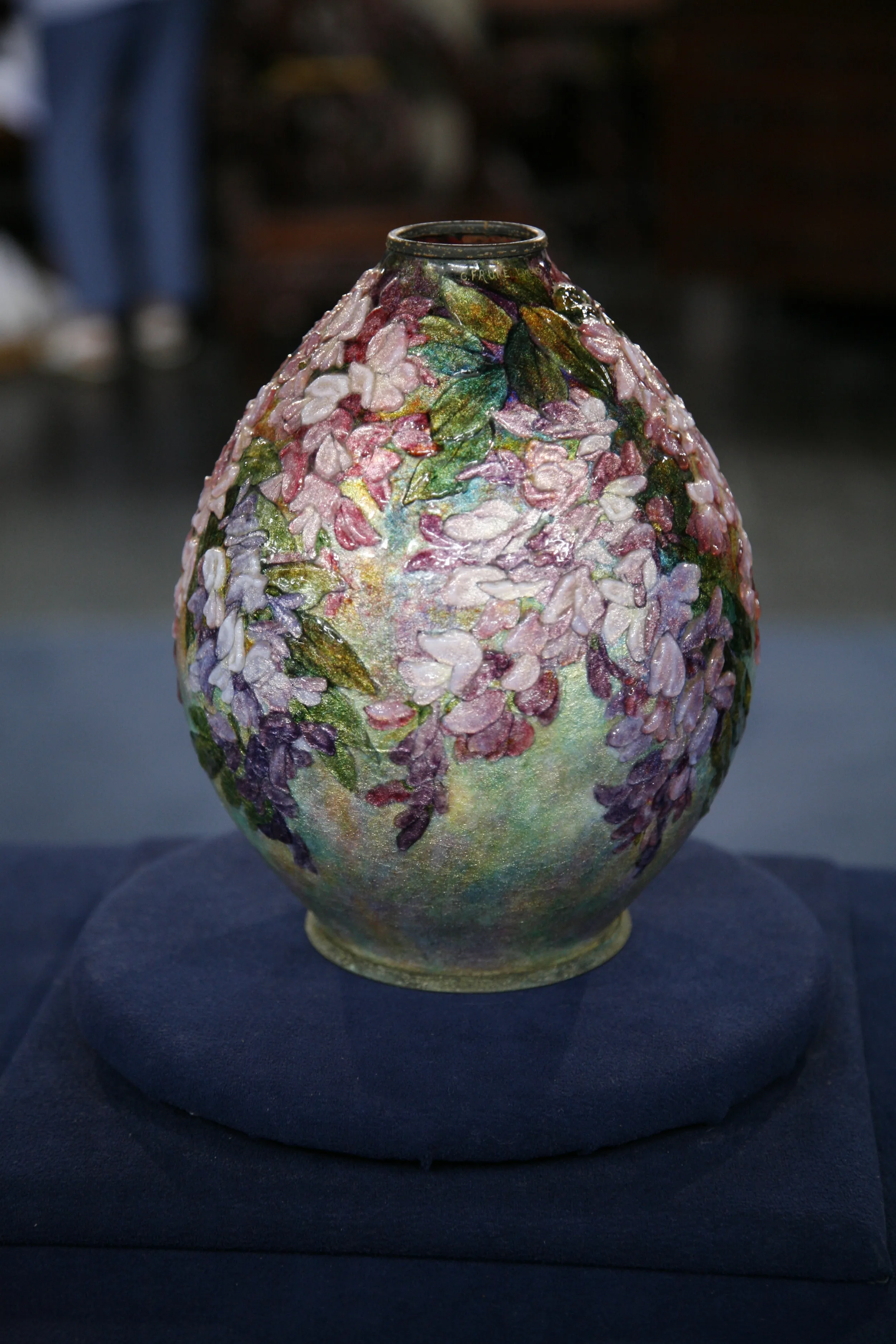
Camille Fauré Enameled Vase, ca. 1925
Understanding Our Appraisals
Executive producer Marsha Bemko shares her tips for getting the most out of ANTIQUES ROADSHOW.
Value can change: The value of an item is dependent upon many things, including the condition of the object itself, trends in the market for that kind of object, and the location where the item will be sold. These are just some of the reasons why the answer to the question "What's it worth?" is so often "It depends."
Note the date: Take note of the date the appraisal was recorded. This information appears in the upper left corner of the page, with the label "Appraised On." Values change over time according to market forces, so the current value of the item could be higher, lower, or the same as when our expert first appraised it.
Context is key: Listen carefully. Most of our experts will give appraisal values in context. For example, you'll often hear them say what an item is worth "at auction," or "retail," or "for insurance purposes" (replacement value). Retail prices are different from wholesale prices. Often an auctioneer will talk about what she knows best: the auction market. A shop owner will usually talk about what he knows best: the retail price he'd place on the object in his shop. And though there are no hard and fast rules, an object's auction price can often be half its retail value; yet for other objects, an auction price could be higher than retail. As a rule, however, retail and insurance/replacement values are about the same.
Verbal approximations: The values given by the experts on ANTIQUES ROADSHOW are considered "verbal approximations of value." Technically, an "appraisal" is a legal document, generally for insurance purposes, written by a qualified expert and paid for by the owner of the item. An appraisal usually involves an extensive amount of research to establish authenticity, provenance, composition, method of construction, and other important attributes of a particular object.
Opinion of value: As with all appraisals, the verbal approximations of value given at ROADSHOW events are our experts' opinions formed from their knowledge of antiques and collectibles, market trends, and other factors. Although our valuations are based on research and experience, opinions can, and sometimes do, vary among experts.
Appraiser affiliations: Finally, the affiliation of the appraiser may have changed since the appraisal was recorded. To see current contact information for an appraiser in the ROADSHOW Archive, click on the link below the appraiser's picture. Our Appraiser Index also contains a complete list of active ROADSHOW appraisers and their contact details and biographies.


