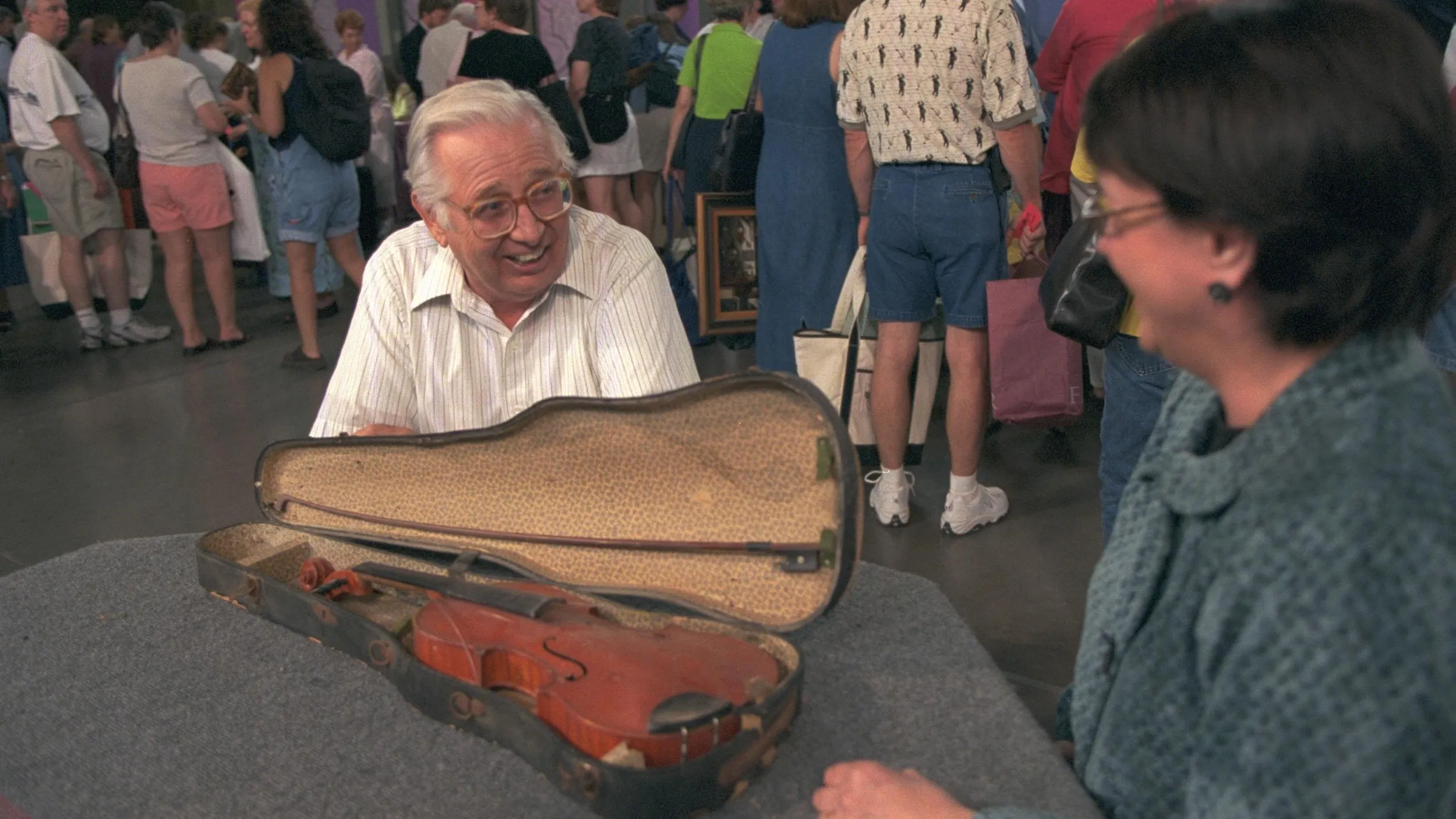
APPRAISER: Jim, thanks for bringing in your family violin. What strikes me is this violin is like so many we see. It's covered with dust. It's got bug larvae in the case. The case is falling apart, and it looks like it's been abandoned for just years. How... can you tell me what you know about this violin?
GUEST: I thought it belonged to… one of my great-aunts, who died as a child back at around the turn of the century, but apparently, it belonged to my Great-Aunt Helen, who died in the '60s.
APPRAISER: Mm-hmm. Well, when was the last time anybody actually opened this case and looked to see what it was?
GUEST: Well, I... a few weeks ago, I opened it up to… you know, check it out before I brought it here, but it's, you know, I've had it since the '60s, and I've probably looked at it maybe once or twice.
APPRAISER: So do you have any sense of who made it or what it is, or its...?
GUEST: No, I don't, I really don't.
APPRAISER: Okay, all right. And was your Aunt Helen a player?
GUEST: She was a musician and an artist. She did a lot of work at Walt Disney Studios, and I know she played the saxophone. I didn't know she played the violin.
APPRAISER: But she was a serious musician.
GUEST: Oh, very serious, yes.
APPRAISER: Yeah. The reason I ask is because this is, um... this is an interesting violin. This is not your standard violin that gets abandoned in... in a house and is actually worth nothing. Um…as you can see... do you mind if I dust it off?
GUEST: Please.
APPRAISER: The back has this wonderful, rich red varnish. I don't know if we can get some of this dust off easily, but it's a beautiful, beautiful varnish, and the craftsmanship is really exquisite. The label that's on the inside, did you look at that?
GUEST: Yes, I've seen that.
APPRAISER: It says Carl Becker, Chicago, 1935, made for William Lewis and Son. Well, Carl Becker was one of the most significant violin makers to work in the United States. In fact, he is part of one of the longest-running dynasties of violin making ever…
GUEST: You’re kidding.
APPRAISER: …in the United States.
GUEST: You're kidding!
APPRAISER: His father, grandfather was a maker. His son is a violin maker. His grandchildren are violin makers, and this is a really significant, professional-quality violin. So the label is correct. It says 1935. At the time that it was purchased, it would have sold for maybe $350... maybe $375. And it's worth a lot more than that right now. Any I – any idea at all?
GUEST: You're going to shock me because I didn't have a clue.
APPRAISER: This is a violin that's worth $25,000 to $30,000.
GUEST: Oh, my God! (laughs) Thank you, Aunt Helen!
APPRAISER: (laughing) Yeah, really!
GUEST: Jiminy Crickets!
APPRAISER: This is – this is going to be a great-sounding violin when it gets fixed up.
GUEST: (laughing): Oh... Whoo!
APPRAISER: Yeah, this was fun. Thank you for bringing it in. It's a nice piece of American history and a significant violin in the history of violin making.
GUEST: Unbelievable!
APPRAISER: Yeah, well done!
GUEST: (laughing)