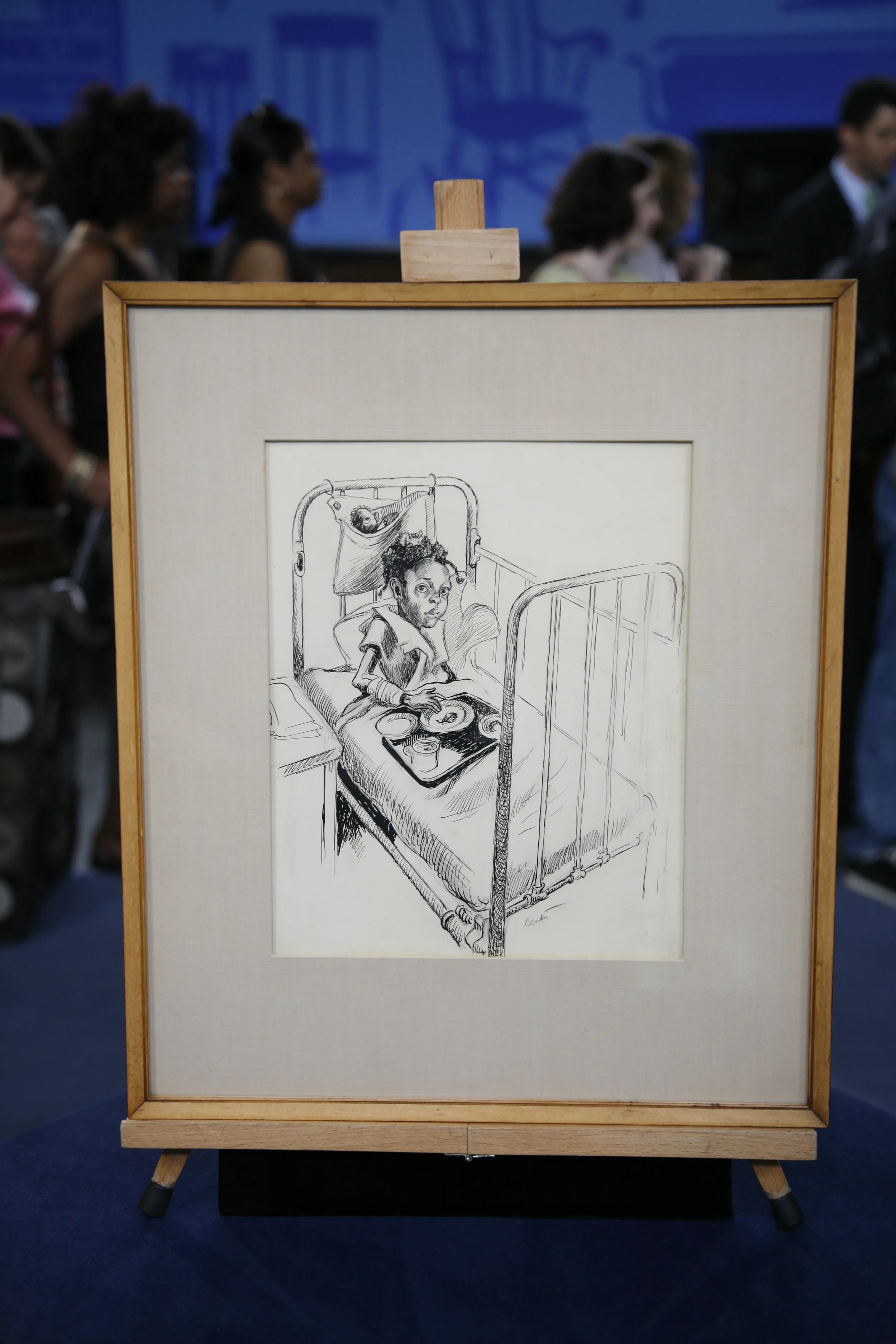
1933 Barney Nelson Crayon Drawing
GUEST: My father, at the age of five years old, went to the Chicago World's Fair in 1933. They saw a crowd of people gathered around on a corner, and my father worked his way up to the front of the crowd and he saw the artist, Barney Nelson. Barney had no arms, and Barney was creating the artwork with, using just his feet.
APPRAISER: Mm.
GUEST: Barney had announced to the crowd that, "The first person who could guess what I'm about to draw next will win the drawing." And when he first began to sketch it, he started off with the tail. And my father spoke up and said, "It's a squirrel."
APPRAISER: Hm.
GUEST: And my father won, won this beautiful drawing.
APPRAISER: According to the 1910 census, Barney Nelson was born in Connecticut about 1879. The census lists him as an African American, and his occupation is listed as crayon artist. He was known during his career as the Armless Phenomenon. He was born armless as a, as a result of a birth defect, and he built a career out of what he was able to do, and that is become a rather accomplished, uh, artist and performing at fairs and in front of crowds. It is crayon on paper, it's an artist's crayon. And as you can see, he made good use of shadows and textures. And notice how really elegant the signature is. It has a really nice, late-19th-century calligraphic style. If this were to be presented in an auction format...
GUEST: Mm-hmm.
APPRAISER: ...a, a very reasonable auction estimate for it would be in the $1,500 to $2,500 range.
GUEST: Okay.
APPRAISER: And we all, we all agree it would not surprise us if it reached $3,000, or maybe even more.
GUEST: Mm-hmm.

$1,500 - $2,500 Auction
Featured In

episode
Springs Preserve, Hour 2
Head to desert oasis Springs Preserve for treasures that are sure to heat up the market.
Drawing

appraisal
1946 Milton Caniff Pastel Drawing
appraisal
Thomas Hart Benton Drawing, ca. 1933

appraisal
Diego Rivera Ink Drawing, ca. 1940

appraisal
1862 Julius Jacob Sketchbook
Understanding Our Appraisals
Executive producer Marsha Bemko shares her tips for getting the most out of ANTIQUES ROADSHOW.
Value can change: The value of an item is dependent upon many things, including the condition of the object itself, trends in the market for that kind of object, and the location where the item will be sold. These are just some of the reasons why the answer to the question "What's it worth?" is so often "It depends."
Note the date: Take note of the date the appraisal was recorded. This information appears in the upper left corner of the page, with the label "Appraised On." Values change over time according to market forces, so the current value of the item could be higher, lower, or the same as when our expert first appraised it.
Context is key: Listen carefully. Most of our experts will give appraisal values in context. For example, you'll often hear them say what an item is worth "at auction," or "retail," or "for insurance purposes" (replacement value). Retail prices are different from wholesale prices. Often an auctioneer will talk about what she knows best: the auction market. A shop owner will usually talk about what he knows best: the retail price he'd place on the object in his shop. And though there are no hard and fast rules, an object's auction price can often be half its retail value; yet for other objects, an auction price could be higher than retail. As a rule, however, retail and insurance/replacement values are about the same.
Verbal approximations: The values given by the experts on ANTIQUES ROADSHOW are considered "verbal approximations of value." Technically, an "appraisal" is a legal document, generally for insurance purposes, written by a qualified expert and paid for by the owner of the item. An appraisal usually involves an extensive amount of research to establish authenticity, provenance, composition, method of construction, and other important attributes of a particular object.
Opinion of value: As with all appraisals, the verbal approximations of value given at ROADSHOW events are our experts' opinions formed from their knowledge of antiques and collectibles, market trends, and other factors. Although our valuations are based on research and experience, opinions can, and sometimes do, vary among experts.
Appraiser affiliations: Finally, the affiliation of the appraiser may have changed since the appraisal was recorded. To see current contact information for an appraiser in the ROADSHOW Archive, click on the link below the appraiser's picture. Our Appraiser Index also contains a complete list of active ROADSHOW appraisers and their contact details and biographies.


