1932 Jessie Teed Hooked Zodiac Rug
GUEST: I brought a rug that has been in my family for many years.
Family lore has it that it was the second-place winner in the World's Fair, 1939, 1940.
We don't have a ribbon for that second place, but we do have a blue ribbon from Macy's, where she won first prize to get into the World's Fair.
APPRAISER: And was this a relative who made this?
GUEST: Yes, it was my great-aunt Jessie Teed, who I guess was known for her work.
APPRAISER: And do you know much about the technique that Jessie Teed was using in making the rug?
GUEST: I only know from an article that she wrote about her work.
She talked about how she used quarter-inch strips of wool.
That was the best, she said, makes a lightweight rug and very sturdy.
She talked about the burlap that she would use from the flour sacks.
APPRAISER: The technique is called hooked rug.
Mm-hmm.
It's where they take the thin wool fabric strips, and with a hook, punch them through the surface and pull them back through to form the carpet's pile.
GUEST: Okay.
APPRAISER: Usually when one thinks about American hooked rugs, you think about folk art.
And this is about as far from folk art as you can get.
Jessie Teed was from Unadilla, New York, which is near Binghamton.
It's sort of rural, South Central New York.
GUEST: Yes.
APPRAISER: And it's a pretty sophisticated design for kind of rural New York at the time.
She's taking these zodiac figures.
It's very, very much an Art Deco design layout.
GUEST: Oh.
APPRAISER: And then in the center, you can see this incredible sailing ship in turbulent, topsy-turvy seas.
And I don't know if you've noticed it, but she signed it "JMT," hidden amongst the waves, which I think is just such a great little touch.
GUEST: It is, and I did not know that until your crew hung the rug up and I saw it.
APPRAISER: She also dated it, which is very difficult to see in here, because it blends in with the waves.
But it's 1932, and I was able to find reference to a 1946 diary written by Nellie Carr, where she's talking about, that Nellie Carr's talking about her grandmother going to live with Jessie and her family.
'Cause Jessie was busy making her rugs and her rug designs, and needed help with the house.
GUEST: Oh, I did not know that.
APPRAISER: Yeah, yeah.
Which really indicates to me that she was approaching this as a profession, and really couldn't be a homemaker anymore because she was busy designing and hooking these rugs.
GUEST: Right.
APPRAISER: Have you ever had it appraised?
GUEST: I had it appraised a few years ago.
The gentleman said it was worth about $2,000 for insurance value.
APPRAISER: In a retail setting today, this rug would be $8,000.
(exclaims softly) GUEST: Really?
APPRAISER: Yeah.
GUEST: Oh, wow.
APPRAISER: For insurance, I would keep it around that same $8,000 mark.
GUEST: Okay.
I will.
APPRAISER: It's just a beautiful, striking, uh, eye-catching design that would have great appeal to a lot of different people.
GUEST: Wow.

$8,000 Retail
$8,000 Insurance
Featured In

episode
Coastal Maine Botanical Gardens, Hour 2
Surprising treasures are in bloom as ROADSHOW continues our fruitful journey to Boothbay, Maine!
Textiles & Needlecraft
appraisal
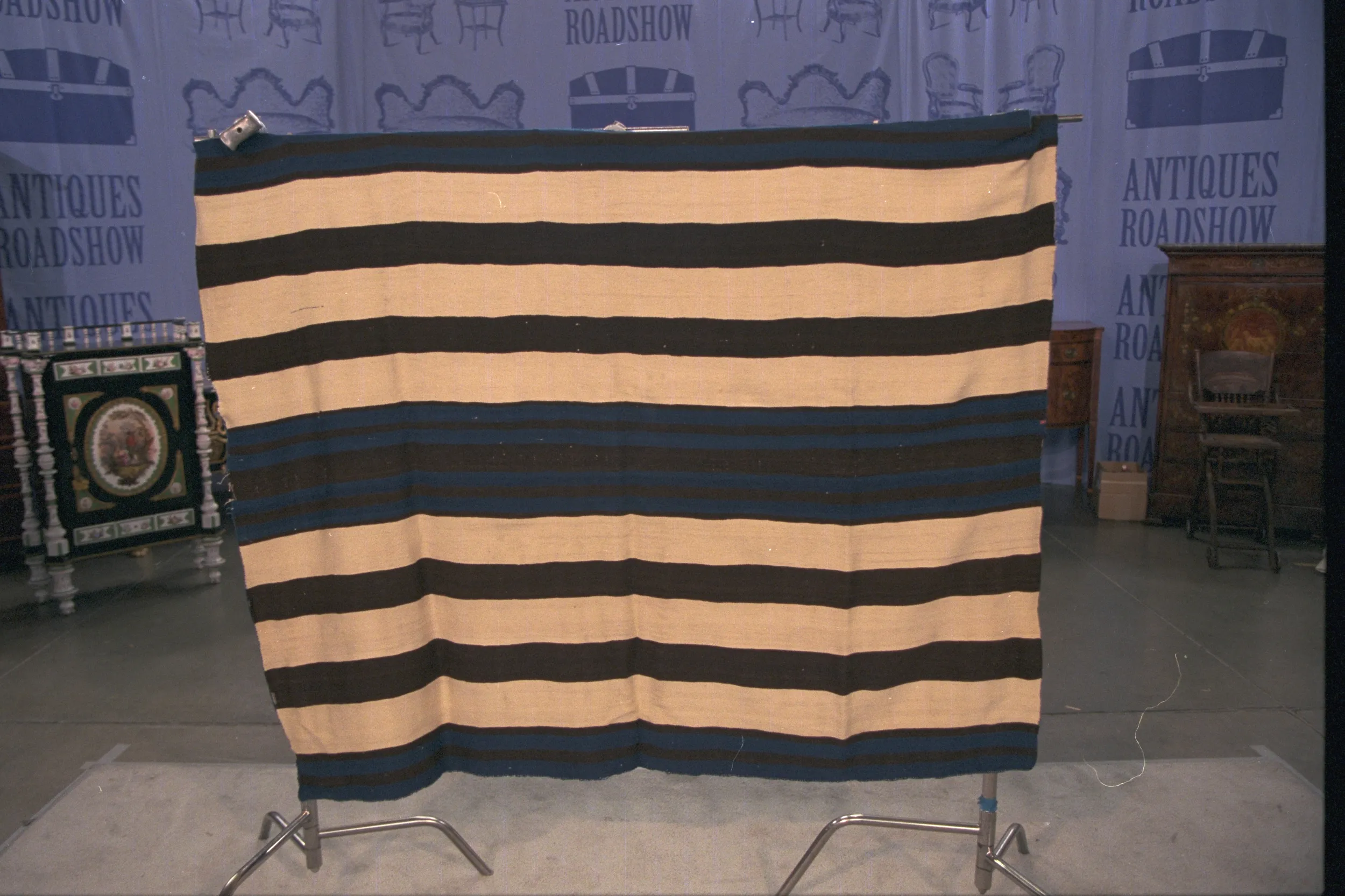
Navajo Ute First Phase Blanket, ca. 1850

appraisal

appraisal

appraisal
Mary Balch School Mourning Picture, ca. 1805
Understanding Our Appraisals
Executive producer Marsha Bemko shares her tips for getting the most out of ANTIQUES ROADSHOW.
Value can change: The value of an item is dependent upon many things, including the condition of the object itself, trends in the market for that kind of object, and the location where the item will be sold. These are just some of the reasons why the answer to the question "What's it worth?" is so often "It depends."
Note the date: Take note of the date the appraisal was recorded. This information appears in the upper left corner of the page, with the label "Appraised On." Values change over time according to market forces, so the current value of the item could be higher, lower, or the same as when our expert first appraised it.
Context is key: Listen carefully. Most of our experts will give appraisal values in context. For example, you'll often hear them say what an item is worth "at auction," or "retail," or "for insurance purposes" (replacement value). Retail prices are different from wholesale prices. Often an auctioneer will talk about what she knows best: the auction market. A shop owner will usually talk about what he knows best: the retail price he'd place on the object in his shop. And though there are no hard and fast rules, an object's auction price can often be half its retail value; yet for other objects, an auction price could be higher than retail. As a rule, however, retail and insurance/replacement values are about the same.
Verbal approximations: The values given by the experts on ANTIQUES ROADSHOW are considered "verbal approximations of value." Technically, an "appraisal" is a legal document, generally for insurance purposes, written by a qualified expert and paid for by the owner of the item. An appraisal usually involves an extensive amount of research to establish authenticity, provenance, composition, method of construction, and other important attributes of a particular object.
Opinion of value: As with all appraisals, the verbal approximations of value given at ROADSHOW events are our experts' opinions formed from their knowledge of antiques and collectibles, market trends, and other factors. Although our valuations are based on research and experience, opinions can, and sometimes do, vary among experts.
Appraiser affiliations: Finally, the affiliation of the appraiser may have changed since the appraisal was recorded. To see current contact information for an appraiser in the ROADSHOW Archive, click on the link below the appraiser's picture. Our Appraiser Index also contains a complete list of active ROADSHOW appraisers and their contact details and biographies.


