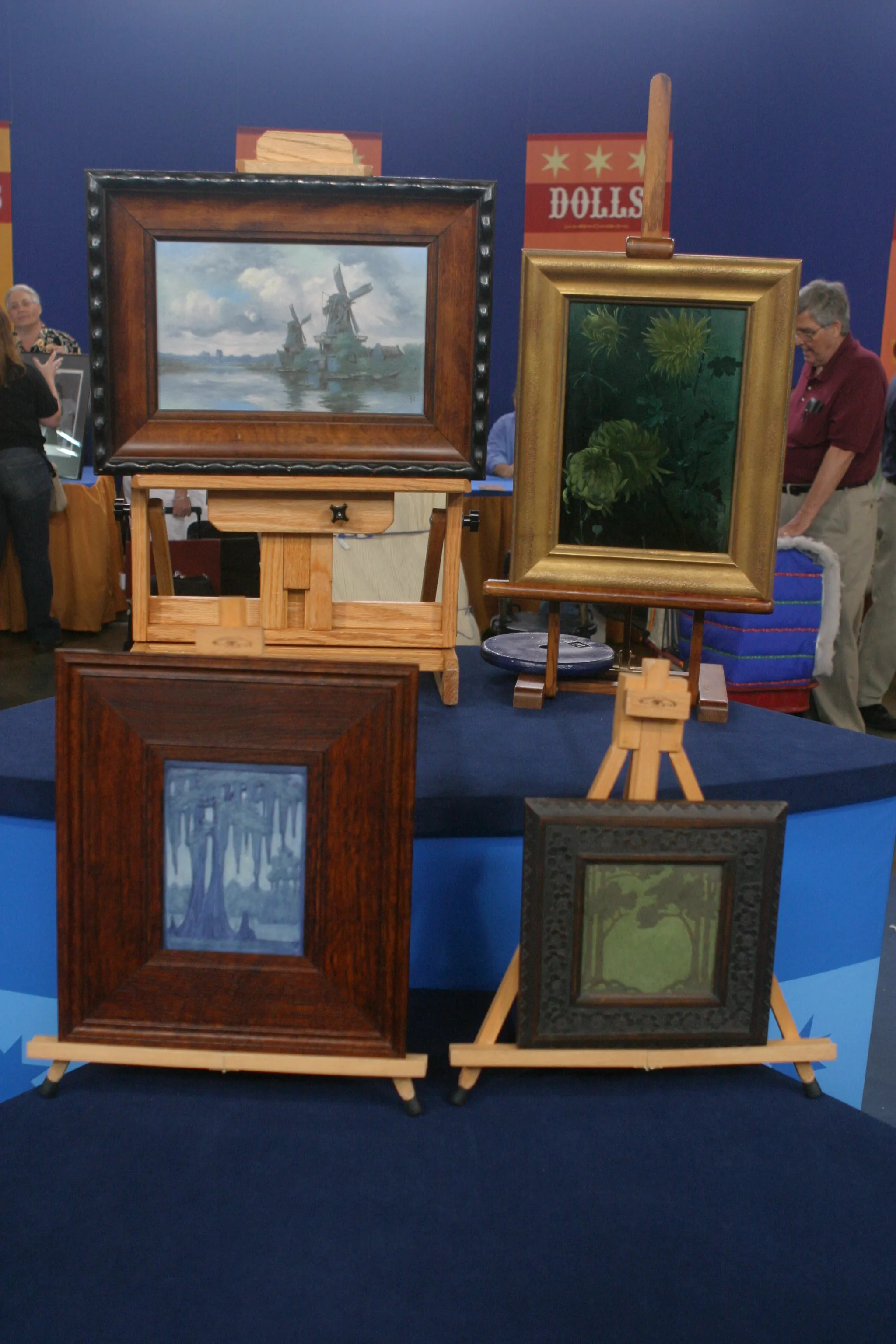
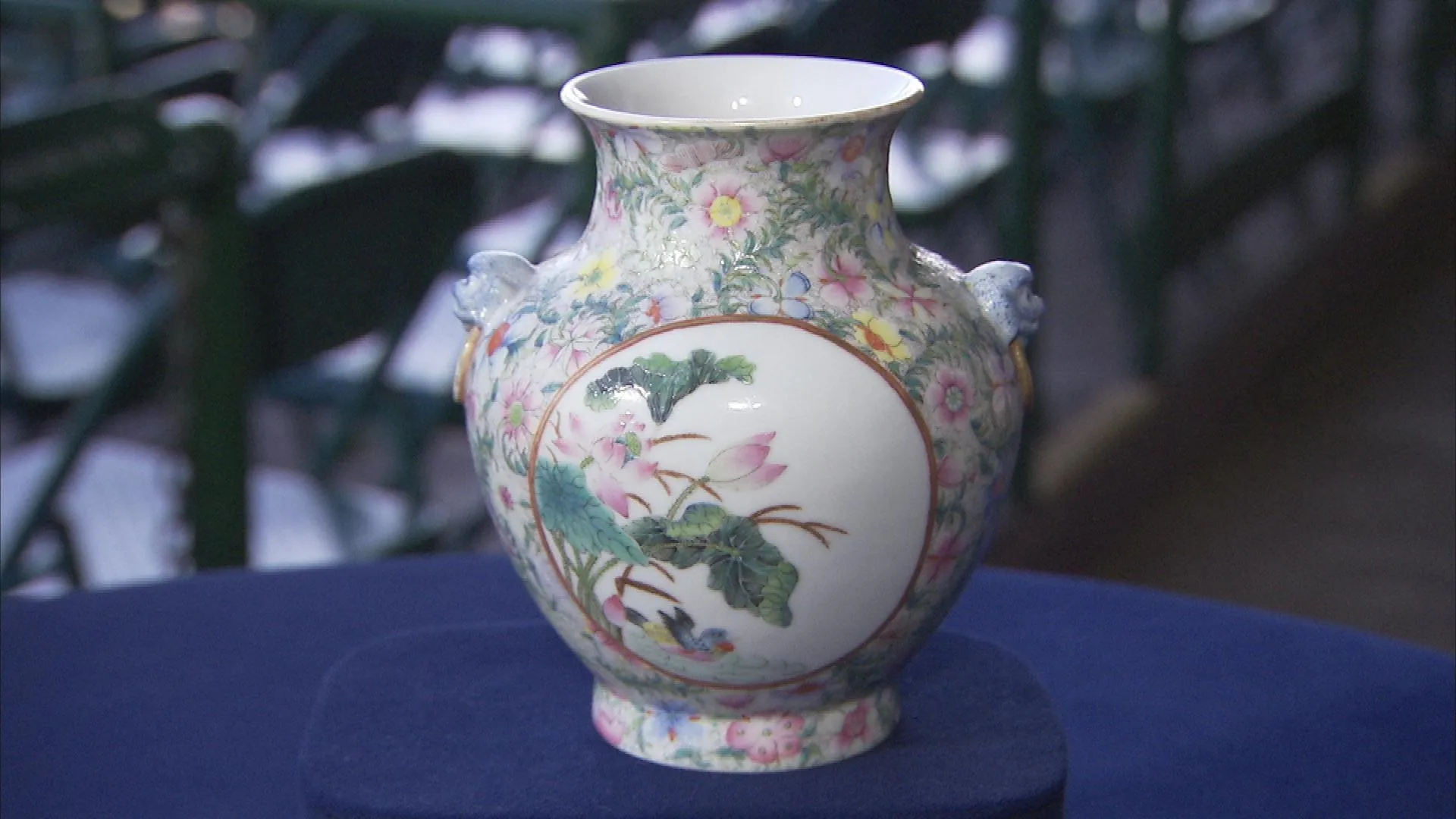
APPRAISER: An art object is always more interesting when we know the social and historic issues involved in its production. I know we've had pieces of Newcomb College on past Roadshows, and I'll briefly review that Newcomb College was a New Orleans-based pottery that worked roughly from about 1900 until about 1940. They were known for using flowers which were indigenous to the area. This is also very typical in that it's a bayou scene with Spanish moss and live oak trees-- very evocative of the old South. The decorations were achieved primarily with modeling the surfaces of the pots by carving. You can see over here, for example, how deeply modeled or tooled or carved the surface of this pot is, very typical of this sort of ware. And also, this color palette is very typical of Newcomb. I did want to ask you how you acquired this piece and how long you've had it.
GUEST: Someone gave it to my mother and my mother gave it to me. I put a plant in it, not knowing what it was, and the plant wouldn't grow because there's no hole in the bottom.
APPRAISER: Uh-huh.
GUEST: And then I put it on the mantel and while it was on the mantel, the earthquake came in Los Angeles. Fortunately, it did not fall off and break. When I moved to Arizona, I did a little more research on it and figured out that it was Newcomb and I got very excited.
APPRAISER: Let's show our viewers the mark that's on virtually every piece of Newcomb College. It's a conjoined "C.N." marking. This mark over here is the artist's signature-- Anna Francis Simpson-- and these are some production marks. This'll tell you the exact date of this piece, which I would guess is about 1913 to 1915. But you're also very fortunate it did not fall off the mantel because a piece like this on today's market is worth somewhere between $2,500 and $3,500.
GUEST: That's exciting.
APPRAISER: Thanks a lot for bringing it in and giving us a chance to hear this story.