GUEST: My husband's great-aunt was a saloon owner in Montana in the early part of the 1900s, you know, 20th century. During the 1920s, she met O.C. Seltzer. He was one of the patrons there, and they became good friends. The family legend is that she even cut his hair. She was close enough friends with him for that. At some point in their friendship, he gave her this and actually another painting that he had done himself, and then I think he went on to New York. She eventually ended up in Las Vegas, married there, and that's where I met her. And these have been hanging in the family home, my in-laws', for all of that time.
APPRAISER: You mentioned that O.C....
GUEST: Olaf Carl Seltzer. Yes.
APPRAISER: Yes, and do you know much about him?
GUEST: Not until I became curious about these. I always thought this one was so beautiful, and I read a little about him online and understood that he was in Montana at the same time. So it seemed to fit our history. I understood that he also met Charles Russell, is it, was another...
APPRAISER: That's correct.
GUEST: ...another artist, and that they met in a saloon. So I was curious at that point, I wonder if it's the saloon where Aunt Beverly worked and owned.
APPRAISER: I wonder if she got any Charles Russells, too. That would be nice to know.
GUEST: Wouldn't that be fun, that'd be a fun discovery.
APPRAISER: Because Charles Russell and Remington, I suppose, are the two-- probably the most sought after artists in Western art.
GUEST: Oh, is that right, yes, yes.
APPRAISER: But you're absolutely right, Seltzer looked on Russell very much as a mentor, and he was very much a willing acolyte.
GUEST: Okay.
APPRAISER: And even helped him out with commissions in New York during his life. Yes. And Russell was a big influence-- both on him personally, and in terms of the kind of art that he was producing. You're quite right, he did move out to Great Falls, Montana, in 1897 with his mother. His father had died. He was originally from Copenhagen, in Denmark.
GUEST: Oh, yes.
APPRAISER: He started painting early on, around about 12, I think. But when he moved out to Montana, he was working on the railroad, and then I think it was around about '44 or so that the railroad laid him off and he spent all his time painting after that.
GUEST: Oh, is that right, okay. So these were earlier than that.
APPRAISER: Yeah.
GUEST: Okay.
APPRAISER: He was a tremendously prolific artist.
GUEST: Okay.
APPRAISER: And in fact, I believe there's in excess of 2,500 paintings by him around.
GUEST: Really?
APPRAISER: He has popped up in the ROADSHOW before. I remember once saying, one of the pieces I was appraising, I said, "Well, of course "if it was a Native American Indian, it would be worth a bit more."
GUEST: Yes.
APPRAISER: And here we have a Native American Indian.
GUEST: Okay, yes.
APPRAISER: And I spoke to our friends in the tribal arts table, and they told me that it's a Northern Plains, a North Plains Indian.
GUEST: Oh, beautiful.
APPRAISER: And they weren't sure, they thought possibly Nez Perce or Blackfoot, but we're not exactly clear on that.
GUEST: Sure, okay, okay.
APPRAISER: So that helps the value of it, too. It is a very striking figure here in the composition. And a medium, which he used frequently, which was oil on board. It's got all the elements that someone collecting Western art would want in a Seltzer. And so at auction, I would feel pretty comfortable putting an estimate of $20,000 to $30,000 on it.
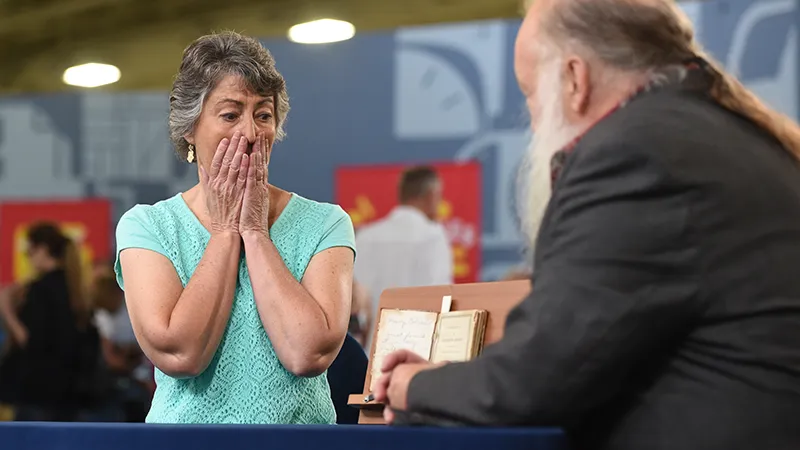
GUEST: (gasps) (laughing): Okay. That's fabulous. That's wonderful.
APPRAISER: He had a lot of haircuts, didn't he?
GUEST: Yeah, he did. I... I... I hope that's all he got.
APPRAISER: Now...
GUEST: I'm just hoping, I'm like oh... But she... she was such a fun character.