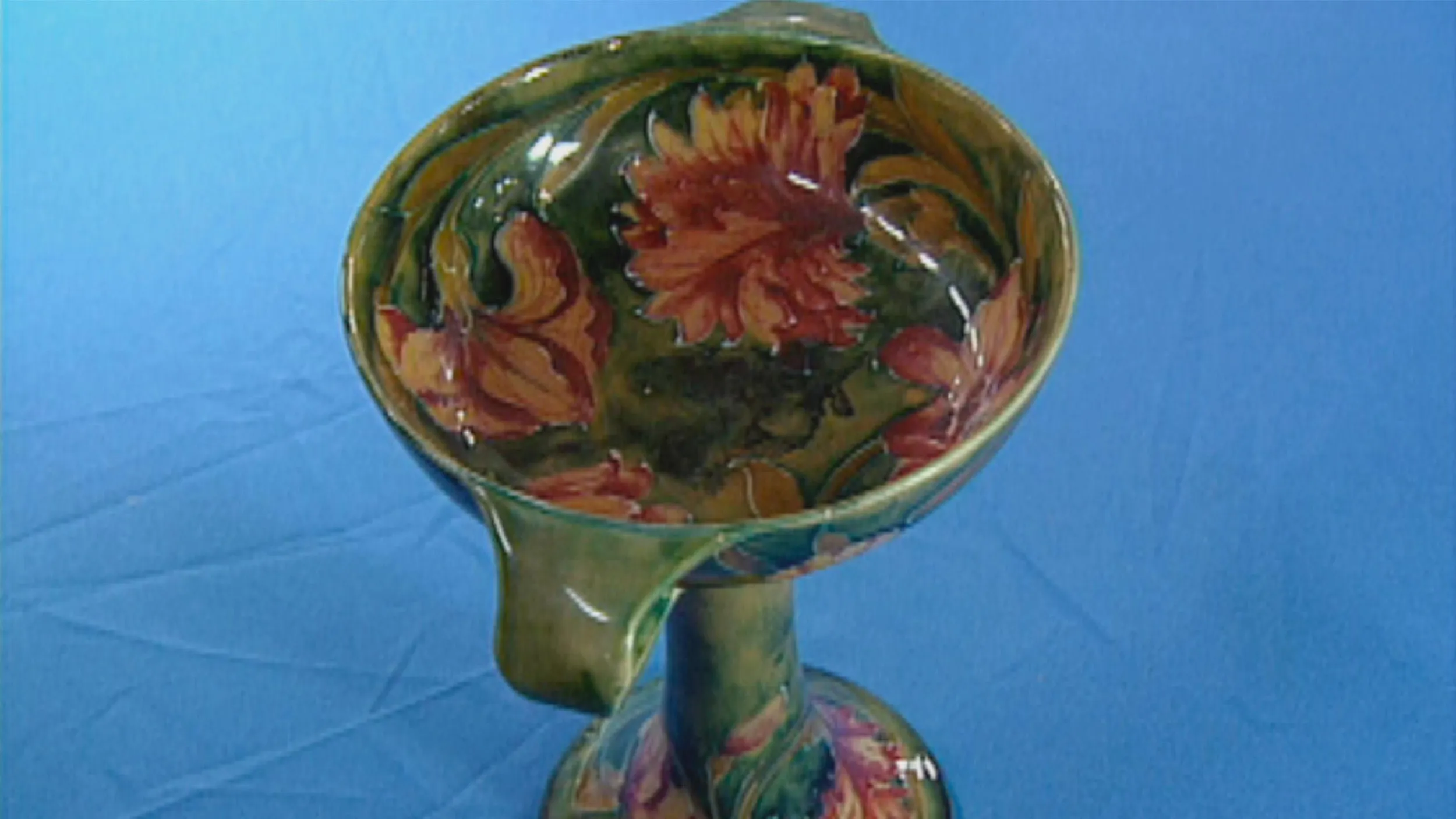
1905 Van Briggle Vase
APPRAISER: So, you were given this vase by your aunt?
GUEST: Yes, uh, well, my great-aunt. She passed away in 1964. And I was about nine, and I was there when the truck delivered all the belongings, and for helping out, I could pick out an item, and this is the item I chose. My mother felt that it was terribly ugly and it was easy to give up.
APPRAISER: Well, it's not for everybody, but you do know a few things about this piece.
GUEST: I do.
APPRAISER: What do you know about this?
GUEST: The date on the bottom is 1905. It's got a double A, for Artemis and Anne Van Briggle. I believe he had TB, and so they moved to Colorado
Springs. I believe the factory is still working right now. But he died in 1904. That's about all I know about the vase.
APPRAISER: Well, it's quite a bit, actually, and very accurate information. It's Artus, not Artemis. But aside from that, you're right on the money. And the factory still is in operation. This is a challenging piece. It's painted with matte glazes. It would have been overseen by his wife, Anne, who survived, of course, and ran the company till around 1912, when it was sold out to businessmen. And this is from that period, that just over the hump, shortly after his death. Artus worked for the Rookwood Company in the 1880s and '90s. Left, as you said, because of ill health and went to Colorado Springs. The climate was thought to be beneficial for those with TB, or consumption, as it was known at the time. And he was at his creative peak just before he died in 1904. But there's a misconception that once he died, the company stopped making good pieces.
GUEST: Yeah.
APPRAISER: And, uh, they're mostly known for rather florid Art Nouveau pieces with embossed decorations, mostly flowers.
GUEST: Mm-hmm.
APPRAISER: And... pieces like this, with these organic glazes, are most unusual. I, I like to say they're academic pieces. They're not for the beginning
collector, but they're for someone who has all the floral pieces and wants something a little more esoteric.
GUEST: Okay.
APPRAISER: A little more challenging, if you will. And so while this is not the sort of Van Briggle that most people think about, even from this period, I was pretty happy to see this come in, because you don't see these every day. Normally, pieces from this period, without embossed decoration, they'd bring a few hundred dollars. I think because this one's as interesting as it is, auction, I would estimate it at between $1,500 and $2,000. So certainly better than most.
GUEST: Okay. I thought, was thinking around $300, so that's... I'm happy with that.

$1,000 - $1,500 Auction
$1,500 - $2,000 Auction
Featured In

episode
episode
Vintage Baltimore 2021, Hour 2
What are treasures from the 2007 Baltimore ROADSHOW worth now?
Pottery
appraisal
William Moorcroft Pottery, ca. 1910

appraisal

appraisal
Majolica Fish Tureen attributed to George Jones & Sons, ca. 1870
appraisal
Palissy Ware Teapot, ca. 1865
Understanding Our Appraisals
Executive producer Marsha Bemko shares her tips for getting the most out of ANTIQUES ROADSHOW.
Value can change: The value of an item is dependent upon many things, including the condition of the object itself, trends in the market for that kind of object, and the location where the item will be sold. These are just some of the reasons why the answer to the question "What's it worth?" is so often "It depends."
Note the date: Take note of the date the appraisal was recorded. This information appears in the upper left corner of the page, with the label "Appraised On." Values change over time according to market forces, so the current value of the item could be higher, lower, or the same as when our expert first appraised it.
Context is key: Listen carefully. Most of our experts will give appraisal values in context. For example, you'll often hear them say what an item is worth "at auction," or "retail," or "for insurance purposes" (replacement value). Retail prices are different from wholesale prices. Often an auctioneer will talk about what she knows best: the auction market. A shop owner will usually talk about what he knows best: the retail price he'd place on the object in his shop. And though there are no hard and fast rules, an object's auction price can often be half its retail value; yet for other objects, an auction price could be higher than retail. As a rule, however, retail and insurance/replacement values are about the same.
Verbal approximations: The values given by the experts on ANTIQUES ROADSHOW are considered "verbal approximations of value." Technically, an "appraisal" is a legal document, generally for insurance purposes, written by a qualified expert and paid for by the owner of the item. An appraisal usually involves an extensive amount of research to establish authenticity, provenance, composition, method of construction, and other important attributes of a particular object.
Opinion of value: As with all appraisals, the verbal approximations of value given at ROADSHOW events are our experts' opinions formed from their knowledge of antiques and collectibles, market trends, and other factors. Although our valuations are based on research and experience, opinions can, and sometimes do, vary among experts.
Appraiser affiliations: Finally, the affiliation of the appraiser may have changed since the appraisal was recorded. To see current contact information for an appraiser in the ROADSHOW Archive, click on the link below the appraiser's picture. Our Appraiser Index also contains a complete list of active ROADSHOW appraisers and their contact details and biographies.


