1878 Napa Valley Wineries Silver-plate Presentation Tray
GUEST: I brought this tray that was given to my family way, way back in 1878. It's my husband's family. He was the fifth generation.
APPRAISER: The fifth generation from his ancestor who was...
GUEST: E. C. Preber. And it was from the Napa-Sonoma wine country. And it was presented to him for all of what he did for the wine industry in California. He was a young man, about 21 years old, and he came over from Germany. So first he immigrated to Mexico, but he wasn't really happy there. And then he came to California.
APPRAISER: Emille Preber got to know some of the biggest, longest lasting names in the winemaking industry, including Krug, Beringer, and others who were...
GUEST: Exactly.
APPRAISER: ...considered really the founding fathers of the wine industry in California. Then, in the early 1870s, he was asked by Krug to go to St. Louis to set up a wine company to help distribute their wines that they're growing in California to the eastern part of the United States. He founds and operates the Napa and Sonoma Wine Company. Then, a few years later, in recognition of all of his efforts on behalf of these California winemakers, they present him with this serving platter made by an American firm called Rogers, Smith and Company, made of silver plate with really ornate decoration around the edge. The double handles on the end to help hold it up, because it is quite heavy.
GUEST: Right.
APPRAISER: And this really fantastic decoration in the center of the reserve...
GUEST: Yes.
APPRAISER: ...depicting Athena, the goddess of war.
GUEST: Yes!
APPRAISER: Below Athena, we have the "P" monogram...
GUEST: Right.
APPRAISER: ...for Preber. And then the presentation inscription, "presented to E.C. Preber. by Charles Krug, J.C. Weinberger, O.W. Craig and Jacob Beringer, as a token of friendship and appreciation of valuable services rendered to the Napa and Sonoma Wine Company." And that's in St. Helena, California, in May of 1878. I realize it's a family heirloom, so you'll be keeping it, so I'd advise an insurance value of $4,000.
GUEST: (quietly): Wow. I didn't even bring it to get any value. I didn't even care. I just think the value. But to be that valuable, I think I probably should get it insured, (chuckling): because it's sure not insured.

$4,000 - $4,000 Insurance
Featured In

episode
Crystal Bridges Museum of American Art, Hour 1
Season 29 Premiere! Kick off an all-new ROADSHOW season at Crystal Bridges Museum of American Art!
Tray
appraisal
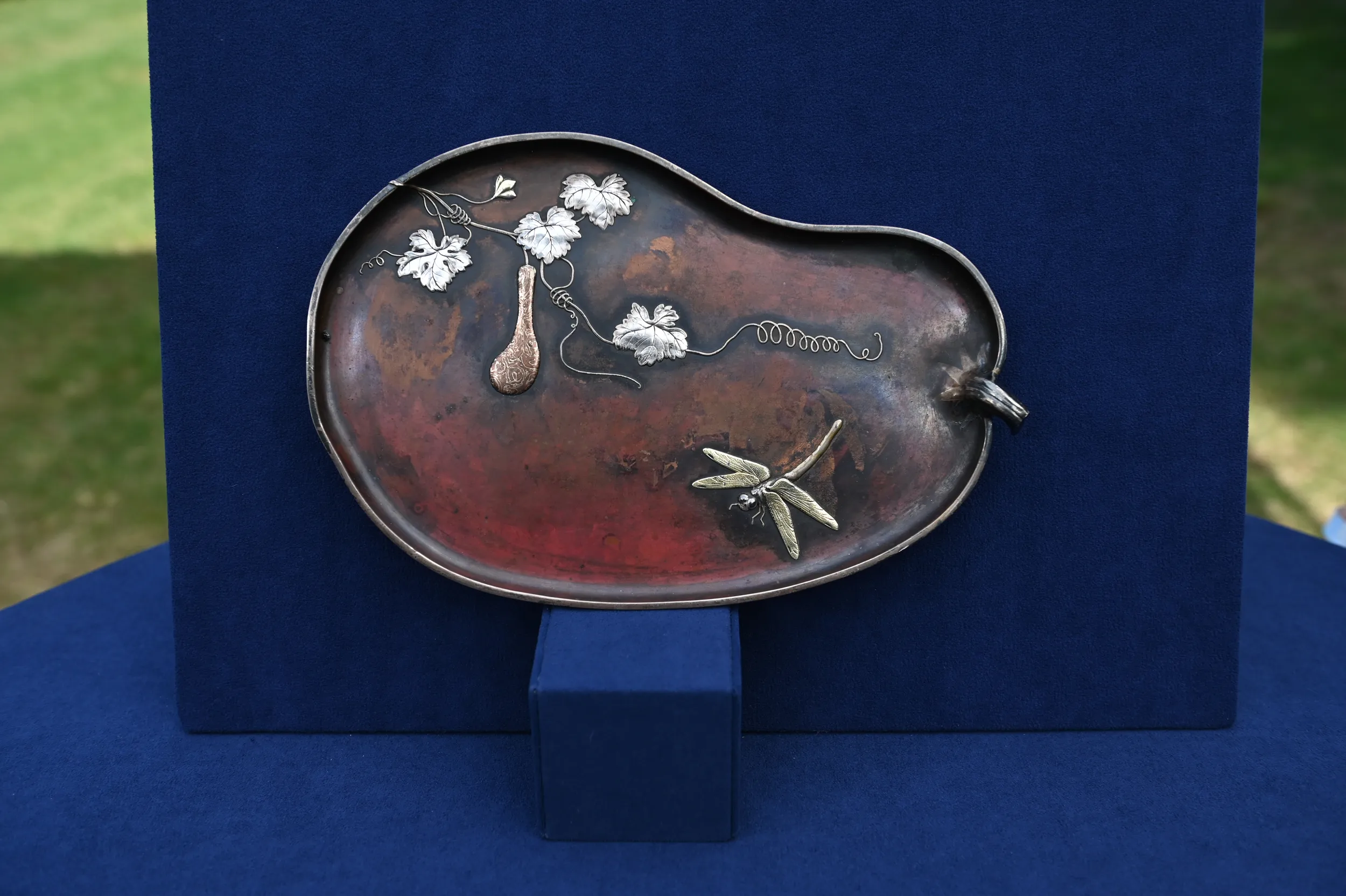
1878 Tiffany & Co. Mixed-metal & Mokume Tray

appraisal
Dale Nichols Group, ca. 1950

appraisal
1950 Hammered Aluminum Turtle-Form Towel Basin

appraisal
Fake Fabergé Set & Wax Case, ca. 1980
Understanding Our Appraisals
Executive producer Marsha Bemko shares her tips for getting the most out of ANTIQUES ROADSHOW.
Value can change: The value of an item is dependent upon many things, including the condition of the object itself, trends in the market for that kind of object, and the location where the item will be sold. These are just some of the reasons why the answer to the question "What's it worth?" is so often "It depends."
Note the date: Take note of the date the appraisal was recorded. This information appears in the upper left corner of the page, with the label "Appraised On." Values change over time according to market forces, so the current value of the item could be higher, lower, or the same as when our expert first appraised it.
Context is key: Listen carefully. Most of our experts will give appraisal values in context. For example, you'll often hear them say what an item is worth "at auction," or "retail," or "for insurance purposes" (replacement value). Retail prices are different from wholesale prices. Often an auctioneer will talk about what she knows best: the auction market. A shop owner will usually talk about what he knows best: the retail price he'd place on the object in his shop. And though there are no hard and fast rules, an object's auction price can often be half its retail value; yet for other objects, an auction price could be higher than retail. As a rule, however, retail and insurance/replacement values are about the same.
Verbal approximations: The values given by the experts on ANTIQUES ROADSHOW are considered "verbal approximations of value." Technically, an "appraisal" is a legal document, generally for insurance purposes, written by a qualified expert and paid for by the owner of the item. An appraisal usually involves an extensive amount of research to establish authenticity, provenance, composition, method of construction, and other important attributes of a particular object.
Opinion of value: As with all appraisals, the verbal approximations of value given at ROADSHOW events are our experts' opinions formed from their knowledge of antiques and collectibles, market trends, and other factors. Although our valuations are based on research and experience, opinions can, and sometimes do, vary among experts.
Appraiser affiliations: Finally, the affiliation of the appraiser may have changed since the appraisal was recorded. To see current contact information for an appraiser in the ROADSHOW Archive, click on the link below the appraiser's picture. Our Appraiser Index also contains a complete list of active ROADSHOW appraisers and their contact details and biographies.


