1875 "Pictorial St. Louis" Atlas
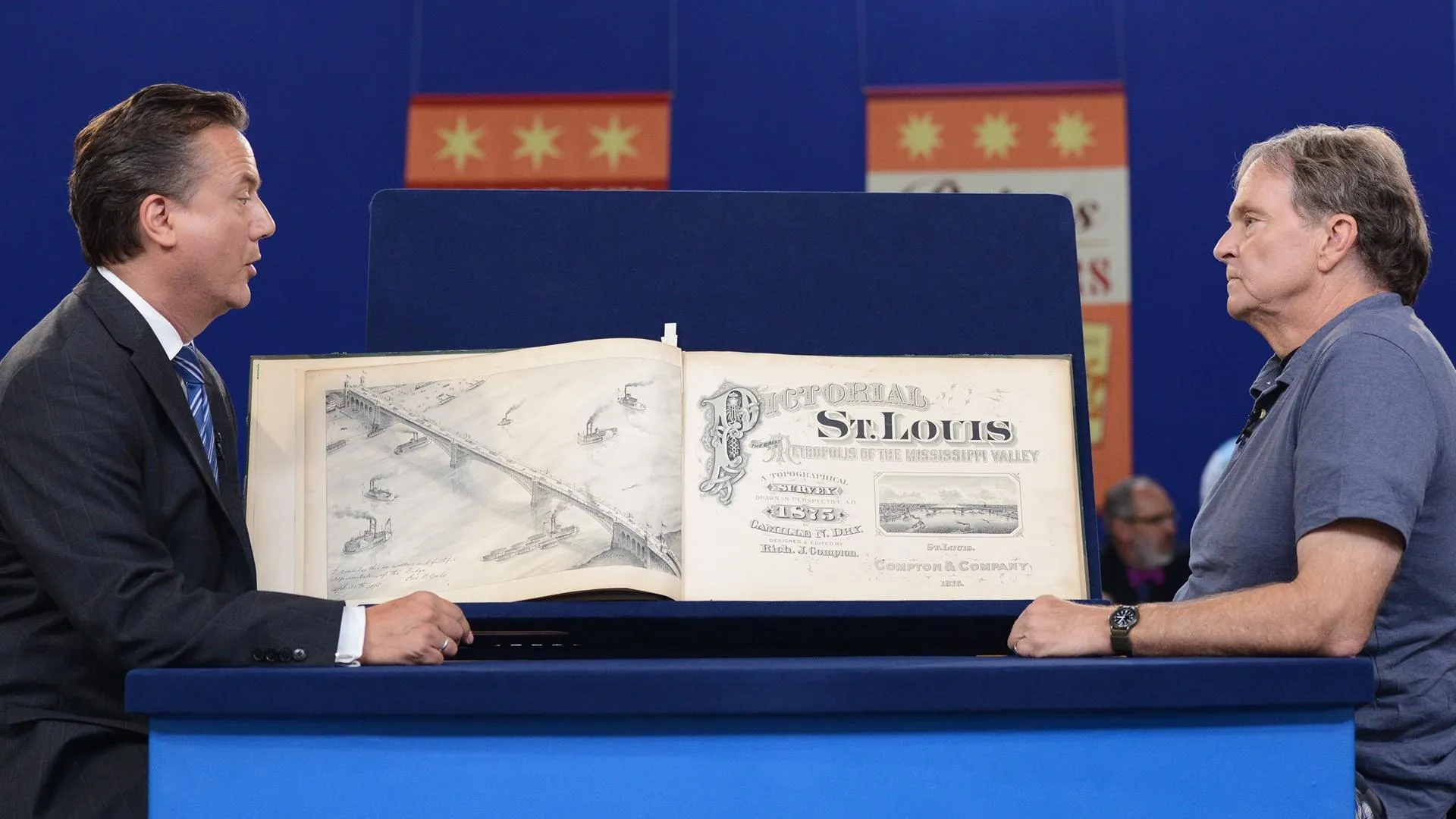
GUEST: My parents, my grandparents, and probably generations beyond them, all came from St. Louis, and after my grandparents died, '94, we went up to clean out their house.
APPRAISER: Mm-hmm.
GUEST: My grandfather was an attorney and a fairly eclectic collector of things. He had a big library of books. He was also a big St. Louis history buff, and so...
APPRAISER: So this caught your eye.
GUEST: It caught my eye. Not only that, I mean, just the story that it told but also the lithographs that were just pretty amazing.
APPRAISER: The book is called Pictorial St. Louis. And it's a perspective map or a bird's-eye map in atlas form of the entire city of St. Louis. Perspective maps have always been made from the 16th century on.
GUEST: Right.
APPRAISER: Mostly in Europe, but they'd be fairly small, and they wouldn't be particularly accurate. This particular production was undertaken by Richard Compton, who was a lithographer and a printer in St. Louis, and he really wanted to recreate the city in lithographic form as an exact replica. So he hired Camille Dry, who was an artist in St. Louis, to do these lithographs and produce the book. It's a fascinating story about how they did it, when you think about it, because they didn't have bird's-eye views of the city.
GUEST: Exactly.
APPRAISER: They sent Mr. Dry up in a hot air balloon...
GUEST: Really?
APPRAISER: ...over the Mississippi to do initial sketches of each of the lithographs.
GUEST: I had no idea.
APPRAISER: And then they would go down and replicate every building, every window, every tree and haystack that they could recognize in the city. What if we have a look at some of these plates? Here's an example of downtown, and you can see, all the streets are illustrated. They have carriages and so forth, trees, churches... I think if we look at the first plate here... You've got waterfront, and where the Gateway Arch would be today...
GUEST: Right.
APPRAISER: Of course, but that was not there. Do you recognize any of the areas in town here?
GUEST: You know, the waterfront has changed so much since this day. The Eads Bridge is still there.
APPRAISER: Right. Let me show you a couple other of these plates, because they're fascinating. Over here, we can see, he went ahead and got these subscribers to pay for the book, and right down here is the original Anheuser-Busch factory.
GUEST: Really?
APPRAISER: So obviously they were drinking beer back then. And another great pastime, of course, in St. Louis, was baseball.
GUEST: Right.
APPRAISER: And baseball was certainly beginning to take hold. We find inside on another plate up here a wonderful replication of a baseball field with a game in progress.
GUEST: I've never seen it.
APPRAISER: And there are additional plates inside of what would be Sportsman's Park, that became the St. Louis Cardinals...
GUEST: Right.
APPRAISER: So it's an incredible tour de force. It has some damage, a few issues with condition.
GUEST: Right.
APPRAISER: Plates have been silked, which is a special film they put on some of them. But nevertheless, it's a really incredible thing and is highly recognized as one of the most important atlases of cities in America in the 19th century.
GUEST: Really?
APPRAISER: It was meant to illustrate the power of the city, in many respects. If you were to take these plates out of the book, which we wouldn't want to do...
GUEST: Right.
APPRAISER: And to lay them in the order in which they were supposed to represent, the map would be 24 feet wide and eight feet high. And because of the cost of producing it-- each one of these is a lithographic plate-- the volume originally sold in 1875 for $25. So that was quite a lot of money at the time, even for a merchant in St. Louis.
GUEST: Yeah.
APPRAISER: This particular volume, even with the condition issues I've stated, would have an auction value of $7,000 to $9,000.
GUEST: Wow. Pretty amazing.

$7,000 - $9,000 Auction
Photos

Featured In
episode
Austin, Hour 3 (2015)
Mark L. Walberg takes a look at antique Mexican saddles in Austin, Hour 3.
Fine Art
appraisal
William Moorcroft Pottery, ca. 1910
appraisal
1952 Picasso Madoura Ceramic Jug

appraisal
Edgar Alwin Payne Painting, ca. 1925
appraisal
American School Portrait, ca. 1820
Understanding Our Appraisals
Executive producer Marsha Bemko shares her tips for getting the most out of ANTIQUES ROADSHOW.
Value can change: The value of an item is dependent upon many things, including the condition of the object itself, trends in the market for that kind of object, and the location where the item will be sold. These are just some of the reasons why the answer to the question "What's it worth?" is so often "It depends."
Note the date: Take note of the date the appraisal was recorded. This information appears in the upper left corner of the page, with the label "Appraised On." Values change over time according to market forces, so the current value of the item could be higher, lower, or the same as when our expert first appraised it.
Context is key: Listen carefully. Most of our experts will give appraisal values in context. For example, you'll often hear them say what an item is worth "at auction," or "retail," or "for insurance purposes" (replacement value). Retail prices are different from wholesale prices. Often an auctioneer will talk about what she knows best: the auction market. A shop owner will usually talk about what he knows best: the retail price he'd place on the object in his shop. And though there are no hard and fast rules, an object's auction price can often be half its retail value; yet for other objects, an auction price could be higher than retail. As a rule, however, retail and insurance/replacement values are about the same.
Verbal approximations: The values given by the experts on ANTIQUES ROADSHOW are considered "verbal approximations of value." Technically, an "appraisal" is a legal document, generally for insurance purposes, written by a qualified expert and paid for by the owner of the item. An appraisal usually involves an extensive amount of research to establish authenticity, provenance, composition, method of construction, and other important attributes of a particular object.
Opinion of value: As with all appraisals, the verbal approximations of value given at ROADSHOW events are our experts' opinions formed from their knowledge of antiques and collectibles, market trends, and other factors. Although our valuations are based on research and experience, opinions can, and sometimes do, vary among experts.
Appraiser affiliations: Finally, the affiliation of the appraiser may have changed since the appraisal was recorded. To see current contact information for an appraiser in the ROADSHOW Archive, click on the link below the appraiser's picture. Our Appraiser Index also contains a complete list of active ROADSHOW appraisers and their contact details and biographies.


