1874 Christofle Bronze & Enamel Vase
GUEST: I brought a vase that I found at my dad's house that he was going to scrap. He bought it at an auction for the scrap metal.
APPRAISER: What drew you to it?
GUEST: The colors. It's just stunning and beautiful.
APPRAISER: Well, what you've brought us today is a French parcel-gilt and patinated bronze and cloisonné enamel vase by Christofle and Co. and designed by Émile Reiber. And it's, in fact, dated 1874. In the mid-19th century, Commodore Matthew Perry had sailed into Tokyo and opened up Japan to trade with the West for the first time in over 200 years. And that opening of trade with the West ignited this rage in Europe and the rest of the Western world for items in the Japanese taste and style. And this was particularly popular in France in that third quarter of the 19th century. So we're in a time period where the Industrial Revolution has led to the advances in the ability to apply gold and silver to other metals via electrolysis. And the company Christofle was very accomplished at this. And in fact, Christofle had purchased the patents to make themselves the sole maker of plated wares like that in France at the time. So the company originated in 1830 as a jewelry maker, but by the point this was made, in the 1870s, they'd really expanded into all types of tablewares, decorative arts, and even furniture. So when Émile Reiber was hired on at Christofle in 1865 to be the chief of their design and composition studio, he brought with him this excitement and just fascination with Japanese and Chinese works of art. And we see that influence in the form of this vase. So the form is that of an ancient Chinese bronze called a hu vase, and that would have held water or wine. We've got just the beautiful figural handles with the kind of dolphin head issuing the S-form scroll on the handles. Do you know what he paid for the...
GUEST: He paid six dollars for it.
APPRAISER: A conservative auction estimate would be $7,000 to $10,000.
GUEST: That's amazing. He did good.
APPRAISER: He did very good. And you did good by saving it from the scrapyard.
GUEST: Yes, I did good, too. (chuckles)

$7,000 Auction
$15,000 Insurance
Featured In

episode
Living History Farms, Hour 3
Luminous treasures are unveiled at Living History Farms. One is $50,000 to $70,000!
Bronze
appraisal
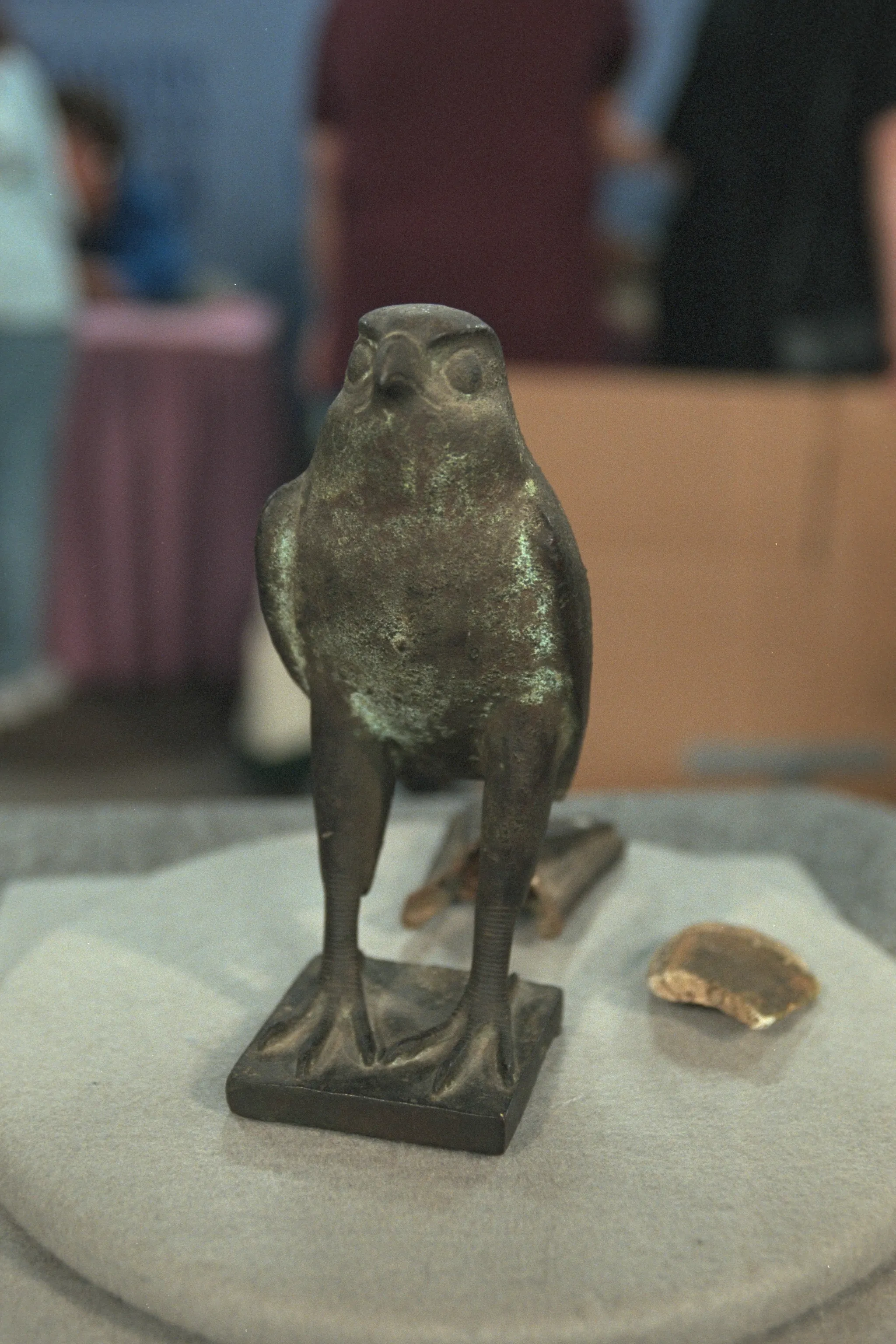
Late Period Egyptian Bronze Falcon

appraisal
19th & 20th-Century Inkwell Collection

appraisal
Edward Onslow Ford Bronze, ca. 1885

appraisal
19th C. Chinese Bronze Guanyin Figure
Understanding Our Appraisals
Executive producer Marsha Bemko shares her tips for getting the most out of ANTIQUES ROADSHOW.
Value can change: The value of an item is dependent upon many things, including the condition of the object itself, trends in the market for that kind of object, and the location where the item will be sold. These are just some of the reasons why the answer to the question "What's it worth?" is so often "It depends."
Note the date: Take note of the date the appraisal was recorded. This information appears in the upper left corner of the page, with the label "Appraised On." Values change over time according to market forces, so the current value of the item could be higher, lower, or the same as when our expert first appraised it.
Context is key: Listen carefully. Most of our experts will give appraisal values in context. For example, you'll often hear them say what an item is worth "at auction," or "retail," or "for insurance purposes" (replacement value). Retail prices are different from wholesale prices. Often an auctioneer will talk about what she knows best: the auction market. A shop owner will usually talk about what he knows best: the retail price he'd place on the object in his shop. And though there are no hard and fast rules, an object's auction price can often be half its retail value; yet for other objects, an auction price could be higher than retail. As a rule, however, retail and insurance/replacement values are about the same.
Verbal approximations: The values given by the experts on ANTIQUES ROADSHOW are considered "verbal approximations of value." Technically, an "appraisal" is a legal document, generally for insurance purposes, written by a qualified expert and paid for by the owner of the item. An appraisal usually involves an extensive amount of research to establish authenticity, provenance, composition, method of construction, and other important attributes of a particular object.
Opinion of value: As with all appraisals, the verbal approximations of value given at ROADSHOW events are our experts' opinions formed from their knowledge of antiques and collectibles, market trends, and other factors. Although our valuations are based on research and experience, opinions can, and sometimes do, vary among experts.
Appraiser affiliations: Finally, the affiliation of the appraiser may have changed since the appraisal was recorded. To see current contact information for an appraiser in the ROADSHOW Archive, click on the link below the appraiser's picture. Our Appraiser Index also contains a complete list of active ROADSHOW appraisers and their contact details and biographies.


