GUEST: My father bought them. He collected Royal Worcester. And then when my mother passed on, this was one of my picks from her collection because they were on the night table by her bed. If she had them on her night table, they meant a lot to her and they must have been good.
APPRAISER: And your mother didn't tell you what they were?
GUEST: If she did, honestly, I've gotten so old I don't remember. (laughs)
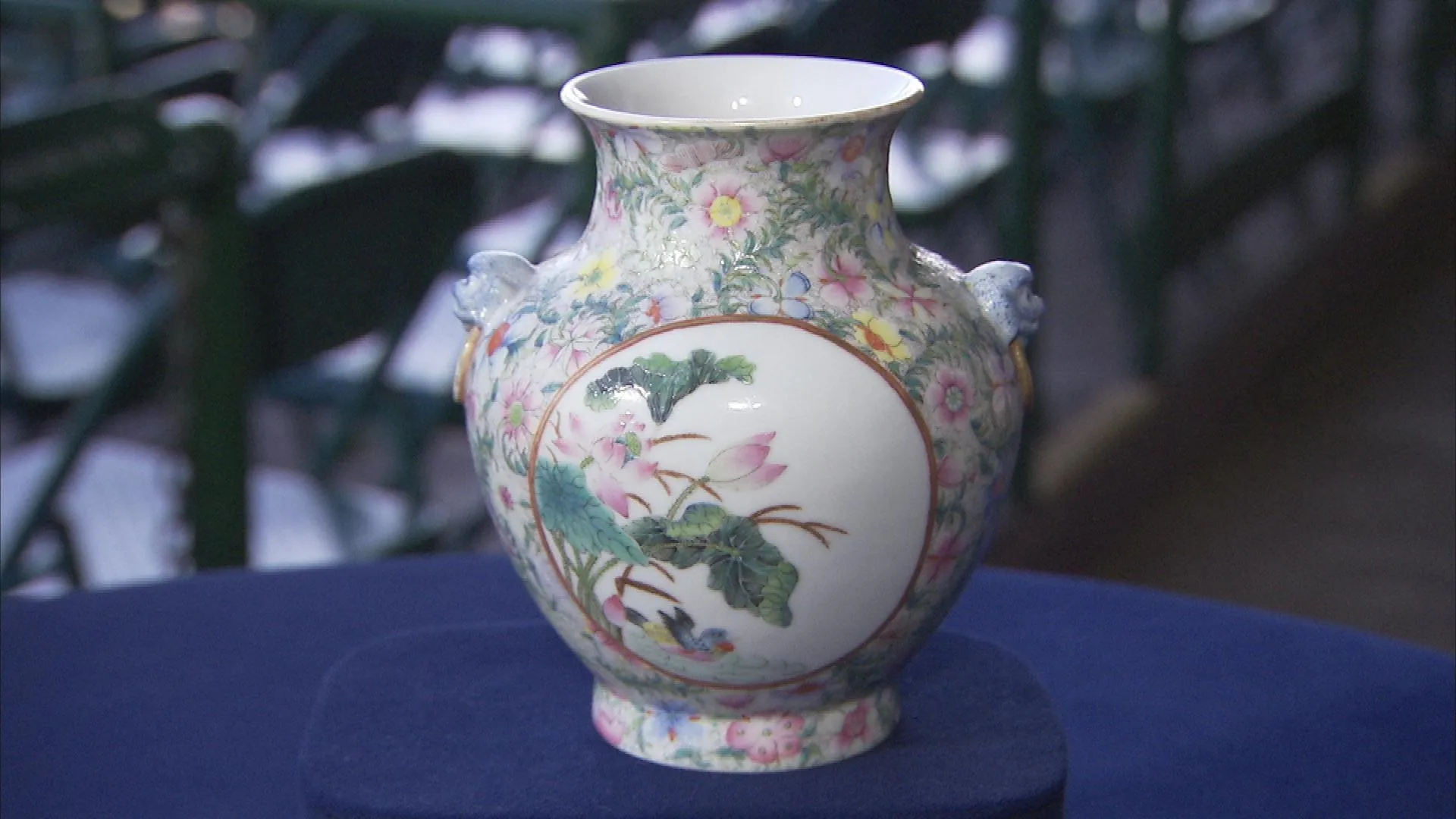
APPRAISER: Okay. They're very striking and the quality of them is very, very high. They're made of porcelain and even though they are rather overtly Japanese in their style, they're English-made. They were made by Royal Worcester. And Royal Worcester is an old, established English porcelain company. Royal Worcester is currently in the process of going out of business after over 250 years of continuous operation. So it's quite sad. But when these were made by Royal Worcester, they were at a high point in their history in terms of success commercially, and also in terms of quality of manufacture. There's really no one else that it's likely to be except for Royal Worcester. But we can confirm that by turning over one of them. And you'll see there's a little printed mark on the bottom. It's kind of a roundel mark. And underneath the round is a number, 73. And that's the date-- 1873-- right in the middle of the reign of Queen Victoria. One of the fashions in 1873, not just in England but also in this country, is what we call Japonisme. And Japonisme is a French word that's used in English to describe the Western interpretation of Japanese art and design. And the art of Japan was somewhat unknown to most Westerners. It wasn't until just a few years earlier in the late 1860s that the first exhibitions of Japanese art and artistry had been held in London and Paris. The shape of them is a traditional Asian form we call a moon flask shape. But the front panels are decorated to simulate carved and stained ivory, which is a Japanese technique. And the main ground of the vases is this speckled gilt finish over a deep blue ground that simulates Japanese lacquer. And the vase maker has gone as far on the back. Both vases have this fabulous flying crane device on the back. This has all been done in porcelain. They've got great condition. I love the form of them, I love the scale of them. They're just the right sort of size to sit on and decorate a mantelpiece. I talked with a couple of my colleagues and we felt that the auction estimate would be at least $10,000 and maybe as much as $14,000 or $15,000.
GUEST: Okay. Thank you. That means a lot to me.
APPRAISER: I also think that the value of them would potentially be a little greater in England than anywhere else.