1870 S.T. Suit Bourbon Ad & 1869 Whiskey Jug
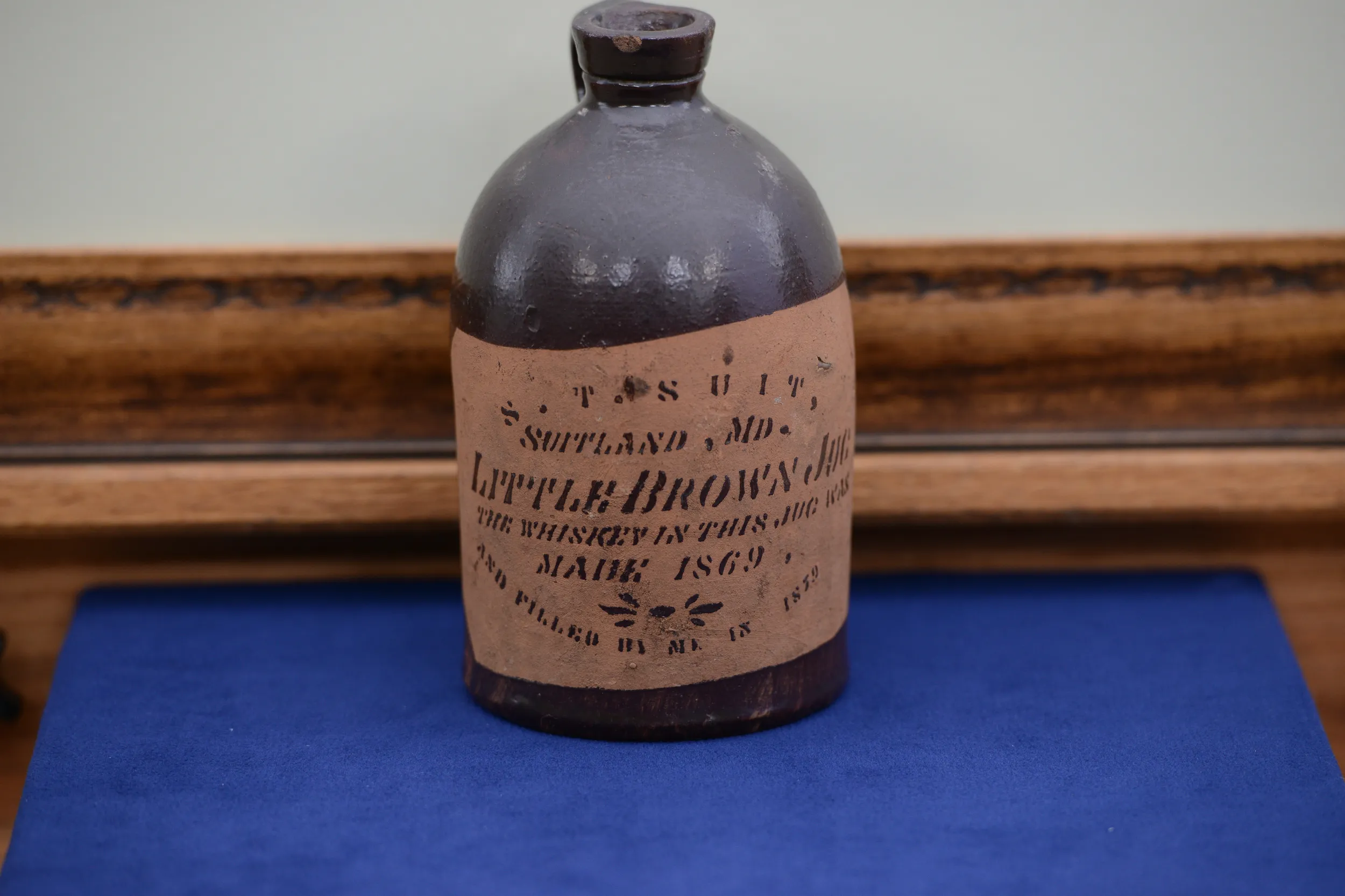
GUEST: I was gifted this lithograph and the bottle of whiskey that goes along with it, it's from a very dear friend, as a retirement gift. It's something I've admired on his wall every time I go to his little cabin.
APPRAISER: When were you given these?
GUEST: Actually, very recently-- last week.
APPRAISER: When did you retire?
GUEST: Today is my last day officially at work, and I'm here at the ROADSHOW.
APPRAISER: (laughs)
GUEST: It just worked out that way.
APPRAISER: This is the best last day at work ever.
GUEST: This is the best last day, yeah.
APPRAISER: Happy retirement.
GUEST: Thank you.
APPRAISER: You brought in your retirement gift. It's not a lithograph.
GUEST: Oh!
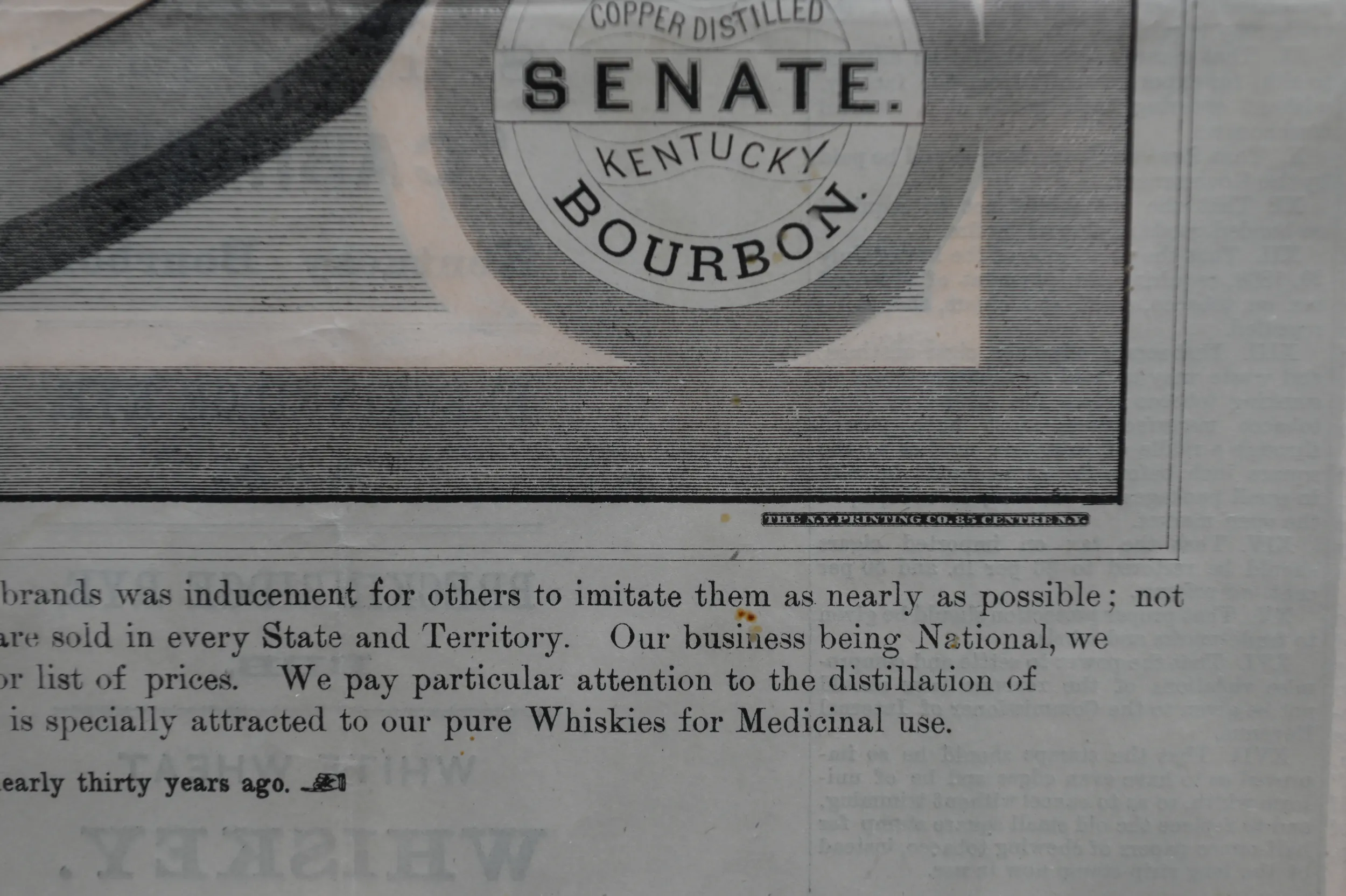
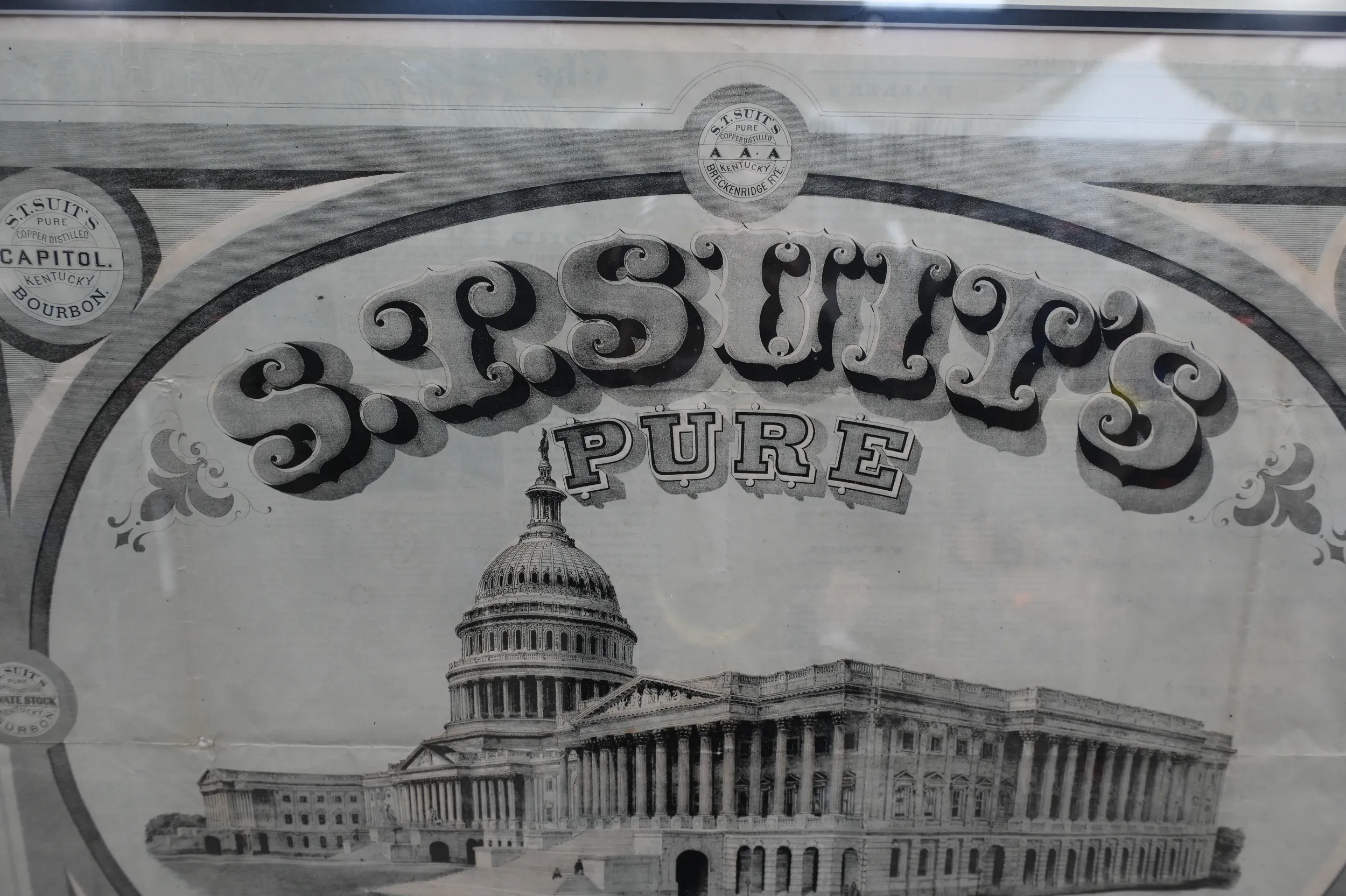
APPRAISER: Uh, it's actually an engraving. Technically, it's not a poster, right? Technically, this is the inside of a newspaper.
GUEST: Right.
APPRAISER: And very technically, it's not any newspaper. It is specifically the "Tobacco Whiskey...
GUEST: "Whiskey"...
APPRAISER: ...Pork Record."
GUEST: Right.
APPRAISER: From 1870.
GUEST: Mm-hmm.
APPRAISER: A periodical whose demise...
GUEST: (laughing)
APPRAISER: ...has shattered hopes and dreams of people across the country. This was the centerfold in that newspaper.
GUEST: Right.
APPRAISER: And it's an advertisement for a whiskey brand that no longer exists.
GUEST: Right.
APPRAISER: S.T. Suit was a whiskey baron, and he was producing whiskey for decades, uh, beginning in the 1850s.
GUEST: Mm-hmm.
APPRAISER: I think his whiskey empire ended in 1888, when he died. He died young. He had three wives...
GUEST: (chuckling)
APPRAISER: ...and, I believe, five different children. I was reading an article in The Washington Post about him, and in 1873, Suit built a school for Black children on his land that he owned in Prince George, in Maryland. And even though he was the son of a slaveholder, his wealth had allowed him to tour the world.
GUEST: Hm.
APPRAISER: And "that taught him that a man is a man, and with this belief, he set himself to work to make good citizens of the hitherto despised and ignorant ex-slaves found in his immediate neighborhood and taught them how to read and write."
GUEST: That's a...
APPRAISER: So he really took his whiskey fortune...
GUEST: Wow.
APPRAISER: ...and put it to what, in the, in the Reconstruction years, was almost unimaginable.
GUEST: Right.
APPRAISER: This is a glorious engraving, uh, advertising a bunch of different brands under his label.
GUEST: Right.
APPRAISER: When I look at this engraving, what I see really reminds me a lot of a bank note, or perhaps a, a bond or a stock.
GUEST: Mm-hmm.
APPRAISER: An engraving, the artist takes a steel plate and literally engraves the image into a steel plate, so you can have very, like, pencil-fine detail, which you see here.
GUEST: There was a collector back in the 1940s, I think, that collected a whole bunch of these and donated 'em to the Smithsonian. And so we were able to find one image of this poster on the inventory. It might be in a, a museum in New York now.
APPRAISER: My research parallels yours exactly.
GUEST: Okay.
APPRAISER: There is, there is one known copy of this in the Smithsonian. From the best of my research, this is only the second copy of this that's known.
GUEST: Wow.
APPRAISER: I'm gonna start with the jug. So I went to my colleagues at the folk art table. I also conferred with some of my colleagues at the collectibles table, and one thing that they both said to me was that whiskey collectibles are really hot right now. The earthenware jug at auction we believe is worth between $500 and $700.
GUEST: Oh, wow. Nice.
APPRAISER: Uh, very unusual. Beautifully done. And as far as the engraving, it's very hard to put on a value based on previous value, 'cause nothing like this has ever come up for sale. So at best, I feel I can give you a conservative value on this. I think at auction, it would sell for between $3,000 and $4,000.
GUEST: Oh, wow, wow. Wow, that's too much.
APPRAISER: I've never heard anybody say, "Wow, that's too much"...
GUEST: Well, it's too much of a gift. I, that's, that, that surprises me.
APPRAISER: It wouldn't surprise me if, at auction, whiskey enthusiasts bid this up to $4,000 to $6,000.

$3,500 - $4,700 Auction
Photos
Featured In
episode
Idaho Botanical Garden, Hour 3
You won’t be-leaf the top Boise find in the “City of Trees,” appraised for up to $100,000!
19th Century

appraisal
1876 John Alexander Stoneware Cooler

appraisal
Braided Rawhide Lariat, ca. 1850
appraisal
American School Portrait, ca. 1820

appraisal
Eskimo Hunting Helmet, ca. 1820
Understanding Our Appraisals
Executive producer Marsha Bemko shares her tips for getting the most out of ANTIQUES ROADSHOW.
Value can change: The value of an item is dependent upon many things, including the condition of the object itself, trends in the market for that kind of object, and the location where the item will be sold. These are just some of the reasons why the answer to the question "What's it worth?" is so often "It depends."
Note the date: Take note of the date the appraisal was recorded. This information appears in the upper left corner of the page, with the label "Appraised On." Values change over time according to market forces, so the current value of the item could be higher, lower, or the same as when our expert first appraised it.
Context is key: Listen carefully. Most of our experts will give appraisal values in context. For example, you'll often hear them say what an item is worth "at auction," or "retail," or "for insurance purposes" (replacement value). Retail prices are different from wholesale prices. Often an auctioneer will talk about what she knows best: the auction market. A shop owner will usually talk about what he knows best: the retail price he'd place on the object in his shop. And though there are no hard and fast rules, an object's auction price can often be half its retail value; yet for other objects, an auction price could be higher than retail. As a rule, however, retail and insurance/replacement values are about the same.
Verbal approximations: The values given by the experts on ANTIQUES ROADSHOW are considered "verbal approximations of value." Technically, an "appraisal" is a legal document, generally for insurance purposes, written by a qualified expert and paid for by the owner of the item. An appraisal usually involves an extensive amount of research to establish authenticity, provenance, composition, method of construction, and other important attributes of a particular object.
Opinion of value: As with all appraisals, the verbal approximations of value given at ROADSHOW events are our experts' opinions formed from their knowledge of antiques and collectibles, market trends, and other factors. Although our valuations are based on research and experience, opinions can, and sometimes do, vary among experts.
Appraiser affiliations: Finally, the affiliation of the appraiser may have changed since the appraisal was recorded. To see current contact information for an appraiser in the ROADSHOW Archive, click on the link below the appraiser's picture. Our Appraiser Index also contains a complete list of active ROADSHOW appraisers and their contact details and biographies.


