GUEST: I brought in a map that I was told was carried during the Civil War and it was Richard Stoddert Ewell's, and it was given to him by Robert E. Lee. And then I also brought a photograph of Robert E. Lee that was signed.
APPRAISER: Where did you get them?
GUEST: They just were always hanging in our house when I was growing up. I used to take them for show-and-tell at school. We are related to Richard Stoddert Ewell. I'm assuming somehow it got to either his younger brother or his cousin and ended up to Sally Ewell, who was my great-grandmother.
APPRAISER: General Ewell was very important to Robert E. Lee. Robert E. Lee was a man that had a small circle of generals that he trusted with his life. And Ewell was one of those generals. Well, Robert E. Lee, one of the most important men in U.S. history, he has a couple of distinctions. He's one of the only men to graduate West Point Military Academy without a demerit. He was also offered leadership of both the Union and the Confederate forces during the Civil War. He said that he couldn't go against his home state of Virginia, so he led the Confederacy. This is actually Robert E. Lee's map.
GUEST: (chuckling) Oh, gees.
APPRAISER: I get chill bumps.
GUEST: (chuckling) Yeah, me too.
APPRAISER: I can't imagine getting to see something like this any time, much less a show-and-tell at school. It's of one of the most important areas of the Civil War. Up here we have the city of Richmond. We have Gaines Mill, Seven Pines. All of those important battles that turned the tide against the Confederacy and eventually the fall of the Confederacy. How many times did Robert E. Lee look at this map and think, "What do I do?" It's just amazing. If we look on the back, we have... ...a couple of really cool old ink inscriptions. It says, "This map was used by General Lee." And in this corner, we have Lee's actual signature. That's not somebody else signing it. That's the general himself.
GUEST: (chuckling) Yeah.
APPRAISER: The condition leaves a little bit to be desired.
GUEST: (chuckling) It's bad.
APPRAISER: But to a guy that loves history, that means that it was used. You can picture this just laying in a tent.
GUEST: Uh-huh.
APPRAISER: And they're strategizing over the map. It doesn't get any better than that.
GUEST: Now you're giving me chills.
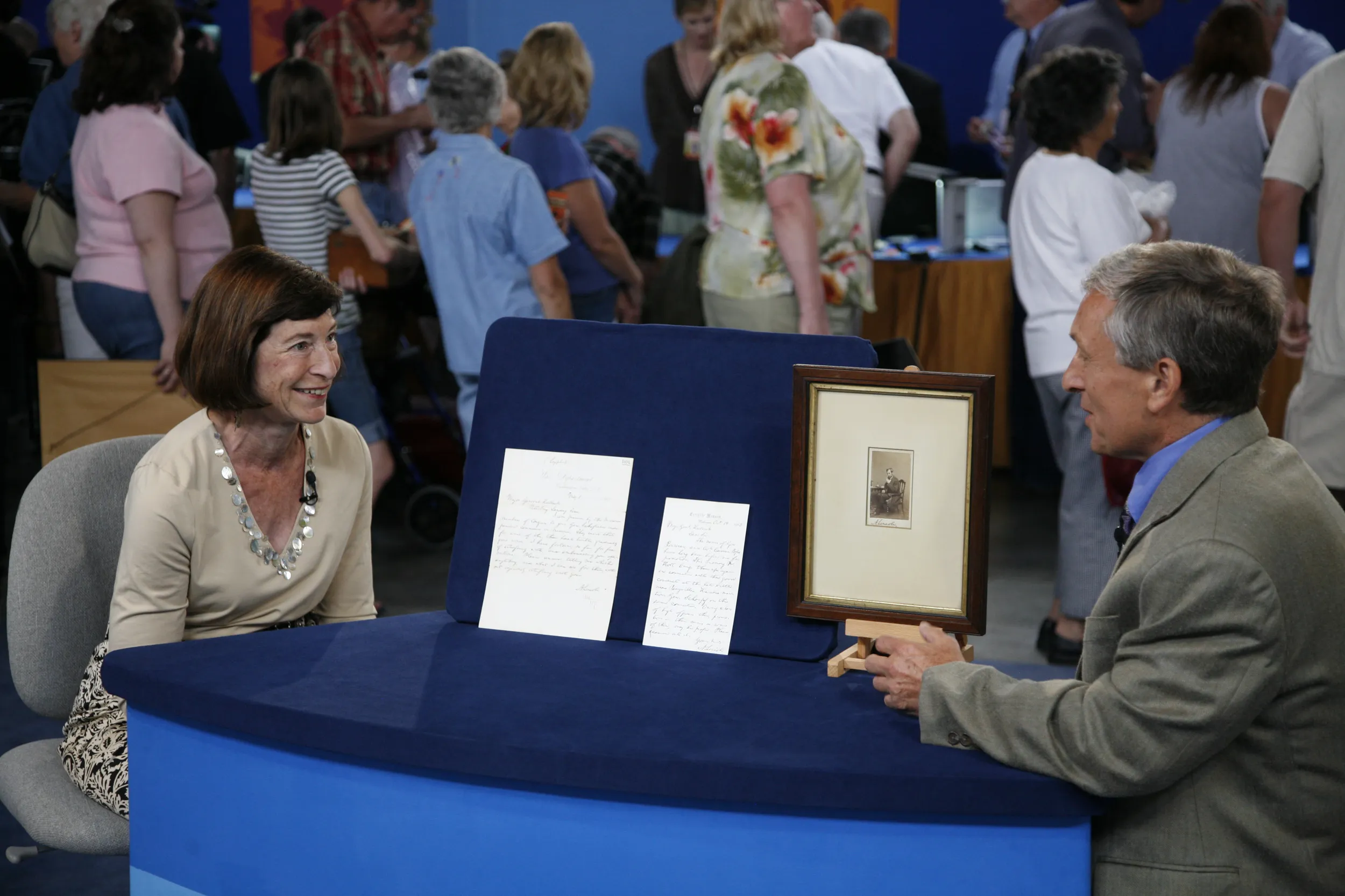
APPRAISER: That's what I'm here for. And we actually have a picture of Lee with his signature on it as well. This is a picture after the Civil War. After the Civil War, Robert E. Lee went to Washington University, which later became Washington and Lee University. It has his signature. The photographs were actually very popular. People would write to Lee, and he always signed them and sent them back because he was that type of person. Have you ever had the pieces appraised?
GUEST: No.
APPRAISER: This is a true piece of American history, not just Confederate history, because this area was the last area of the Civil War. It was the most important one where they were hanging on, just barely surviving. Conservatively, I think as a set, in the retail situation would easily bring $50,000 to $75,000.
GUEST: (chuckling) Oh, my gosh.
APPRAISER: It wouldn't surprise me on the right day if it were to go to an auction for this piece to bring $100,000.
GUEST: Oh, my gosh. Well, my brother will be excited. (chuckles)
APPRAISER: These images, there are actually quite a few of these that are available. And they usually sell in the $5,000 range.
GUEST: $5,000?
APPRAISER: Just for the image. I would definitely insure it for $100,000. It's the history that's wrapped up in this map that really grabs you.
GUEST: Yeah.
APPRAISER: By sundown tonight, I would take this to a framer and I would have it out of this frame.
GUEST: Okay.
APPRAISER: Because this is a piece of history that needs to be preserved. And I love the old frame. It's got to go. (chuckles) I've been here for 13 years. That's the most fantastic thing I have gotten to hold in the time I've been on ROADSHOW.
GUEST: Oh, my gosh.