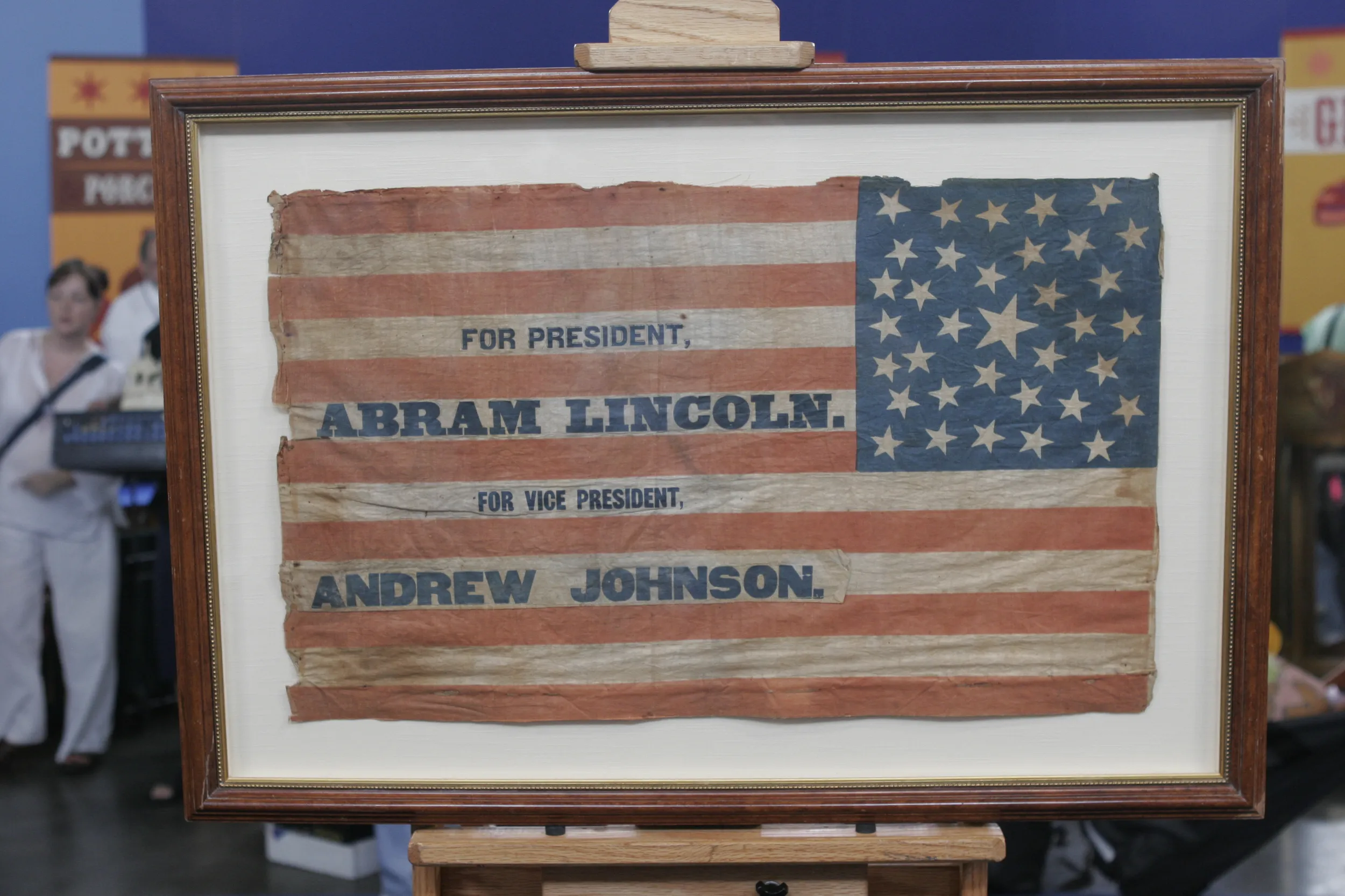
1864 Lincoln & Johnson Campaign Flag
GUEST: I came upon this flag cleaning out my parents' home. I've had it for about 30 years, and it had been stored in a biography of Abraham Lincoln. My dad was a World War II veteran. He loved Americana. He loved American history. He loved to go to auctions, estate sales, and collect things. However, I don't know where he got this or when he got it. I never knew about it during his lifetime. Of course, this is President Lincoln and his running mate, Andrew Johnson, and I... Uh, I believe that this was the 1864 campaign.
APPRAISER: That's correct. It was an interesting campaign. The Civil War was still grinding on. Lincoln was afraid that he might lose the election. In fact, he was pretty sure he was going to lose. He was running against George McClellan, who was a celebrated, uh, Civil War general, at, at least among some circles. Lincoln was thinking, "What can I do to help my ticket?" And he turned to the border states and found Andrew Johnson, who was a staunch Unionist from Eastern Tennessee. He'd been the governor of Tennessee, and Lincoln looked at him, he said, "He's sort of a Southerner. This might swing Kentucky and, and Missouri into my camp. Let's get Andrew Johnson on the ticket." I think that he probably chose him reluctantly. Johnson was a virulent racist. I mean, he was the antithesis of, of Lincoln.
GUEST: Mm-hmm.
APPRAISER: But he fit the bill. And they did get elected, as you know. After the election and after Lincoln was assassinated on April 15, 1865, Johnson, who succeeded him, proceeded to try to undo everything he did that was helping, uh, African Americans.
GUEST: Mm-hmm.
APPRAISER: But this is a flag that would-- I think you're correct-- probably would've been used in a local campaign...
GUESDT: Mm-hmm.
APPRAISER: ...where it might've been waved in a little parade. The flag itself is made out of polished cotton.
GUEST: Okay.
APPRAISER: It's a printed flag. The "Lincoln and Johnson" has been hand-painted. Normally, they're mass-produced, they're stenciled on. The ribbon is actually a piece of silk. Lincoln campaign flag collectors find flags from this election are much scarcer than the 1860 campaign, and so they're willing to pay a premium for those flags. A name flag, which is what this is...
GUEST: Mm-hmm.
APPRAISER: ...it just has names of the candidates on there...
GUEST: Mm-hmm.
APPRAISER: ...is considered great, but if you're really looking for the greatness of the greatness of the greatness, you want a picture of the candidate. They're very rare-- incredibly rare. This flag is a pretty rare flag. It's rare because it's small. Most of the campaign flags are 18 by 24. This is the first one that I've seen this size, and certainly the first one that I've ever seen where it's been hand-painted. What do you think it's worth?
GUEST: I hope it's worth a couple thousand dollars.
APPRAISER: I would place an auction value on it of between $5,000 and $7,000.
GUEST: Okay. Wow! Excellent-- excellent.
APPRAISER: (chuckles)
GUEST: My dad would just love seeing it here. (chuckling) So, thank you.

$5,000 - $7,000 Auction
Featured In

episode
Castle Farms, Hour 2
See Michigan marvels unveiled during ROADSHOW’s stop at Castle Farms in Charlevoix! — Mon, April 6, 2026
Flag
appraisal
Lincoln Presidential Campaign Flag, ca. 1864

appraisal
31-star Flag & Silhouettes, ca. 1850

appraisal
1995 Civil War "Bonnie Blue" Flag Reproduction

appraisal
World War II USS Plaice Kill Flag
Understanding Our Appraisals
Executive producer Marsha Bemko shares her tips for getting the most out of ANTIQUES ROADSHOW.
Value can change: The value of an item is dependent upon many things, including the condition of the object itself, trends in the market for that kind of object, and the location where the item will be sold. These are just some of the reasons why the answer to the question "What's it worth?" is so often "It depends."
Note the date: Take note of the date the appraisal was recorded. This information appears in the upper left corner of the page, with the label "Appraised On." Values change over time according to market forces, so the current value of the item could be higher, lower, or the same as when our expert first appraised it.
Context is key: Listen carefully. Most of our experts will give appraisal values in context. For example, you'll often hear them say what an item is worth "at auction," or "retail," or "for insurance purposes" (replacement value). Retail prices are different from wholesale prices. Often an auctioneer will talk about what she knows best: the auction market. A shop owner will usually talk about what he knows best: the retail price he'd place on the object in his shop. And though there are no hard and fast rules, an object's auction price can often be half its retail value; yet for other objects, an auction price could be higher than retail. As a rule, however, retail and insurance/replacement values are about the same.
Verbal approximations: The values given by the experts on ANTIQUES ROADSHOW are considered "verbal approximations of value." Technically, an "appraisal" is a legal document, generally for insurance purposes, written by a qualified expert and paid for by the owner of the item. An appraisal usually involves an extensive amount of research to establish authenticity, provenance, composition, method of construction, and other important attributes of a particular object.
Opinion of value: As with all appraisals, the verbal approximations of value given at ROADSHOW events are our experts' opinions formed from their knowledge of antiques and collectibles, market trends, and other factors. Although our valuations are based on research and experience, opinions can, and sometimes do, vary among experts.
Appraiser affiliations: Finally, the affiliation of the appraiser may have changed since the appraisal was recorded. To see current contact information for an appraiser in the ROADSHOW Archive, click on the link below the appraiser's picture. Our Appraiser Index also contains a complete list of active ROADSHOW appraisers and their contact details and biographies.


