1859 Oil on Wooden Panel Painting
GUEST: It belonged to my great-grandfather. He acquired it back in the '30s. I really have enjoyed this painting. I actually asked my mother for the painting. It was something I wanted to add to my collection of art.
APPRAISER: So the painting depicts three moths. The painting is an oil on panel. James Abbott McNeill Whistler, 1834 to 1903. Arguably, the most important American artist who settled in Europe of the 19th century. He was born in Massachusetts, but ultimately, by the 1850s, settled abroad. A bit of a bon vivant in his day, he was friendly with other artists-- Degas, Courbet, Fantin-Latour; also critics and authors Charles Baudelaire, John Ruskin. The interest in pattern and color became paramount in his work. This composition would represent a lot more solidity, the kind of thing that one would associate with an earlier part of Whistler's career. It says "Whistler" and what I read as "'59," which would be 1859. Do we know where it was acquired? Do we know how much was paid for it?
GUEST: I do not know. It could have possibly, uh, come from, uh, the Randolph H-Hearst collection. My grandfather had purchased, uh, several pieces from that collection back in the, the '30s.
APPRAISER: Okay. To be able to purchase works from that collection in the '30s, one would need to be a person of some means, I would think.
GUEST: He was very wealthy. Uh, he was a inventor, entrepreneur.
APPRAISER: I was not aware of, nor could I find, anything in the artist's oeuvre which really is similar to this. That I could not find this work led me to question a little bit what we're looking at. '59 was when Whistler moved to London. He never went back to America after the 1850s. I am not entirely convinced, in fact, have some doubts, regrettably, that this is the work of Whistler. We have a painting that I could not find in the online catalogue raisonné. Also, I'm not aware of this subject matter having been treated by Whistler. The signature is not entirely consistent with other Whistler signatures with which I have familiarity. Kind of a game of inches, but there's something about it that just doesn't seem to necessarily ring true, although, aesthetically, it's a wonderful painting. An artist as important as Whistler requires authentication. As with the case of most artists from the 19th and 20th century, there is one leading authority. We would suggest the leading expert, Margaret MacDonald in Scotland, be the final word. If not by Whistler, who created it? I'm not certain. Today at auction, I think you're probably talking about $1,000 to $1,500.
GUEST: Okay. And if it were to turn out to actually be, do you have any idea?
APPRAISER: I had a feeling you were going to ask me then. I think we're probably talking about a painting that, on the conservative end, could be $300,000 to $500,000 at auction today. Maybe even more.

Photos


Featured In

episode
Stan Hywet Hall & Gardens, Hour 3
Visit Akron, OH for astonishing finds, including one $120,000 to $180,000 treasure!
2D & 3D Art Media

appraisal
Frank Zappa Painting, ca. 1960

appraisal
Edgar Alwin Payne Painting, ca. 1925
appraisal
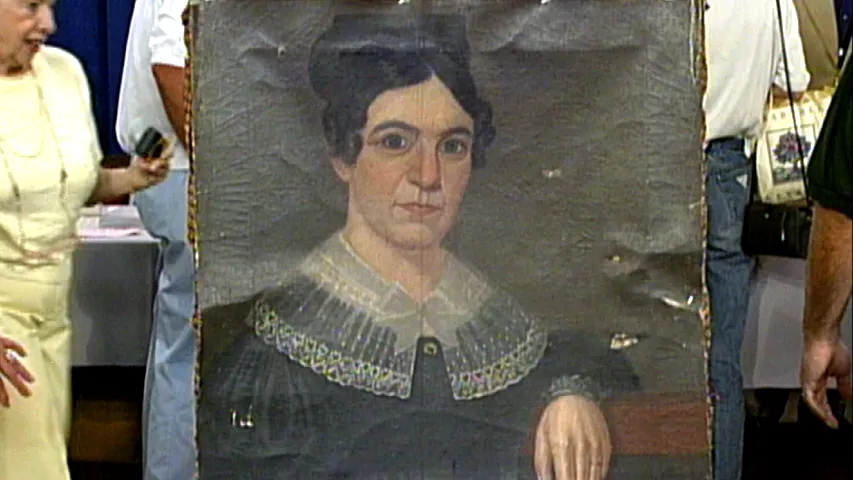
American School Portrait, ca. 1820
appraisal
Understanding Our Appraisals
Executive producer Marsha Bemko shares her tips for getting the most out of ANTIQUES ROADSHOW.
Value can change: The value of an item is dependent upon many things, including the condition of the object itself, trends in the market for that kind of object, and the location where the item will be sold. These are just some of the reasons why the answer to the question "What's it worth?" is so often "It depends."
Note the date: Take note of the date the appraisal was recorded. This information appears in the upper left corner of the page, with the label "Appraised On." Values change over time according to market forces, so the current value of the item could be higher, lower, or the same as when our expert first appraised it.
Context is key: Listen carefully. Most of our experts will give appraisal values in context. For example, you'll often hear them say what an item is worth "at auction," or "retail," or "for insurance purposes" (replacement value). Retail prices are different from wholesale prices. Often an auctioneer will talk about what she knows best: the auction market. A shop owner will usually talk about what he knows best: the retail price he'd place on the object in his shop. And though there are no hard and fast rules, an object's auction price can often be half its retail value; yet for other objects, an auction price could be higher than retail. As a rule, however, retail and insurance/replacement values are about the same.
Verbal approximations: The values given by the experts on ANTIQUES ROADSHOW are considered "verbal approximations of value." Technically, an "appraisal" is a legal document, generally for insurance purposes, written by a qualified expert and paid for by the owner of the item. An appraisal usually involves an extensive amount of research to establish authenticity, provenance, composition, method of construction, and other important attributes of a particular object.
Opinion of value: As with all appraisals, the verbal approximations of value given at ROADSHOW events are our experts' opinions formed from their knowledge of antiques and collectibles, market trends, and other factors. Although our valuations are based on research and experience, opinions can, and sometimes do, vary among experts.
Appraiser affiliations: Finally, the affiliation of the appraiser may have changed since the appraisal was recorded. To see current contact information for an appraiser in the ROADSHOW Archive, click on the link below the appraiser's picture. Our Appraiser Index also contains a complete list of active ROADSHOW appraisers and their contact details and biographies.


