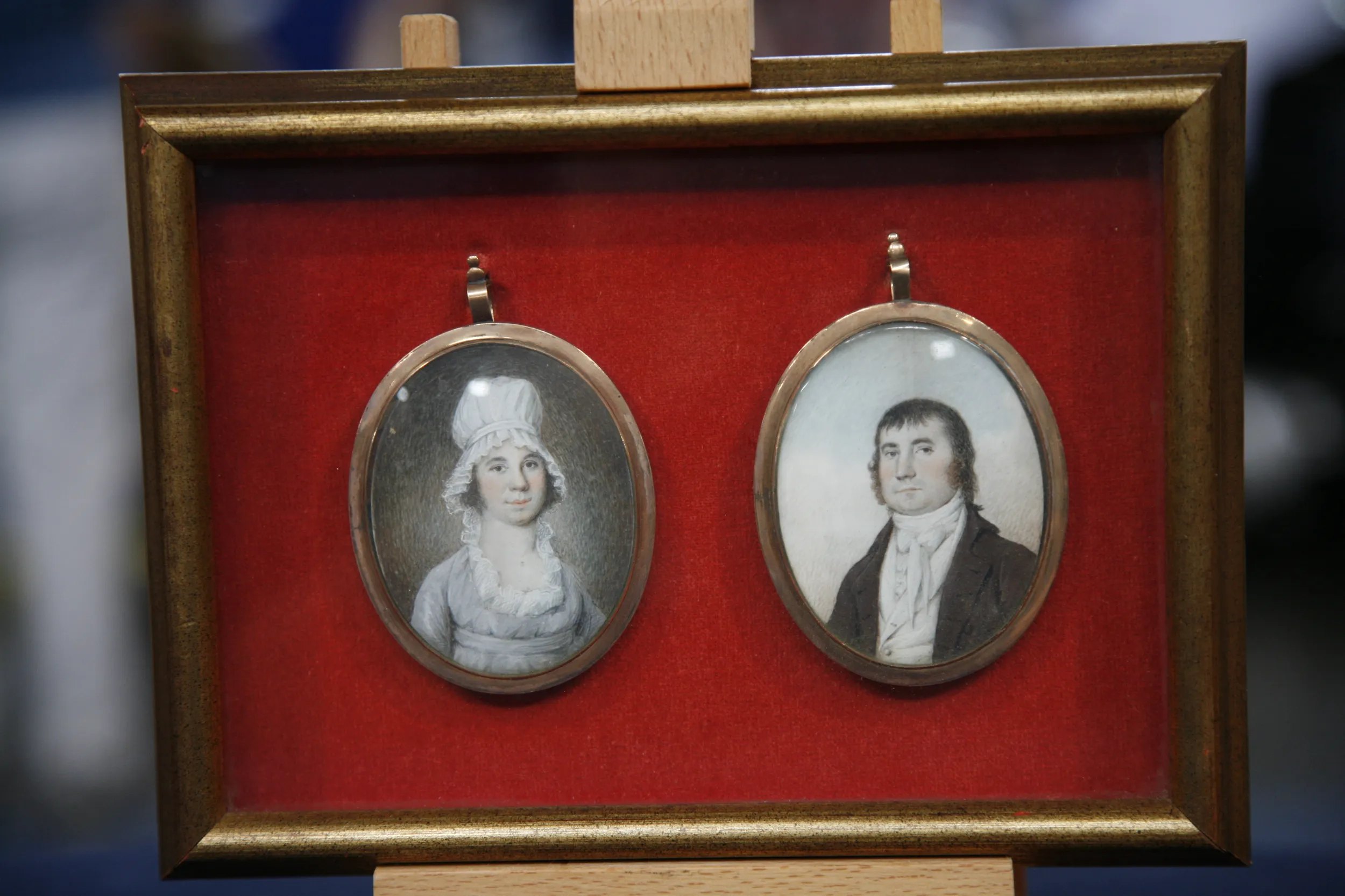
GUEST: They were drawn by Audubon, who of course, it... were known for birds.
APPRAISER: Yeah.
GUEST: But, these are people. And he drew them to make a little money so that he could continue drawing birds.
APPRAISER: Ah-hah.
GUEST: He got about five dollars apiece, or maybe five dollars for both.
APPRAISER: Do you know who this, who the sitters are?
GUEST: Yes. The lady is Eliza Lytle.
APPRAISER: Okay.
GUEST: And she is the wife of Colonel... General William Lytle, who are both related to me.
APPRAISER: They've been in your family since they were drawn?
GUEST: Yes.
APPRAISER: Wow.
GUEST: They've been in the family, passed along to the oldest child.
APPRAISER: So, you mentioned it's Audubon, it's John James Audubon.
GUEST: Yes.
APPRAISER: Actually, he was born in Haiti, believe it or not, in 1785. Came to America when, I think, he was about 18 years old, and was an exceptional artist. When he did these, it was 1820. One of them is signed in the back, it says, "Cincinnati, October 1820."
GUEST: Hmm. Why was he in Cincinnati?
APPRAISER: Well, that was pretty much the American frontier at the time. He was out there in Kentucky and Ohio. They had a business venture that failed terribly, and he needed to make money. So he started doing portraits of the frontier's couples.
GUEST: Mm-hmm.
APPRAISER: This is probably seven to ten years before he got really interested in the birds. "The Birds of America" started in about 1827, '28. And this is seven or eight years before that.
GUEST: Eliza was much younger than she looks. She looks old.
APPRAISER: Yup.
GUEST: But she was about 40-something and sick. She died shortly after the portrait was done.
APPRAISER: Oh, she did?
GUEST: And the general went on to be a military man, surveying land in the West.
APPRAISER: Yes, he was one of the frontier surveyors. He was appointed general by President Jackson not until after this was drawn. This drawing was, as I said, 1820, and I believe he was appointed general about 1830. The fact that they've been in your family for 200 years...
GUEST: Yeah.
APPRAISER: Stayed together, facing each other happily today. The quality of the workmanship is extraordinary. These drawings are pencil and charcoal, so you can see the skill set. And that's why Audubon is a household name today, as perhaps one of America's most noteworthy artists. I know there's a label on the back of both of them that says they were exhibited at the National Gallery in 1980 in a very important exhibition of American portrait art.
GUEST: Oh.
APPRAISER: That's extraordinary, to have that provenance. Audubon, as you know, is really well-known for "The Birds of America," which was a series of terrific, 400 bird engravings and... Color engravings that went on to become extremely popular and, and are extremely valuable today. There's one portrait that came up at auction 15 years ago.
GUEST: Mm-hmm.
APPRAISER: So, that's the basis that I can tell. And these are a little bit better than that portrait, and this is a pair. So my guess is that these today at auction would bring somewhere between $80,000 and $120,000.
GUEST: Oh, my goodness! (laughs) And I took them to a big auction house, and they said they were, wouldn't value them because they were valued under $10,000.
APPRAISER: Oh, my goodness!
GUEST: Oh, my goodness.
APPRAISER: Well, that's changed. The auction record 15 years ago was $48,000 for a single drawing of a man that was not in very good shape.
GUEST: Gosh, oh, I'm very surprised.
APPRAISER: So, as, at... we are, to the really, really delightful. As I say, the quality is just extraordinary. If they were birds, if they were original watercolors of birds, they'd probably be worth two to two-and-a-half times that.
GUEST: (laughs)
APPRAISER: Maybe as much as, as a quarter of a million dollars. The birds do command a higher price. They come up more frequently in the marketplace. But for American history, it doesn't get much better than to have a pair of portraits like this.
GUEST: Thank you. (chuckles): Goodness.
APPRAISER: I would say a minimum of $150,000 would make sense for insurance.