1818 Chester County Redware Jar
GUEST: I brought in a crock from 1818. It's been in the family. There was a farm at one point outside Philly that my grandfather had, and he rented out the barn and, and all, we had a place we could go and stay there. And whether that came from that area, I don't know.
APPRAISER: Is that in Chester County?
GUEST: I believe so, yes.
APPRAISER: Because I do think you have a Chester County piece.
GUEST: Wow.
APPRAISER: This redware jar would've been made of locally sourced clay. Potteries in Chester County in the late 18th and early 19th century, they used a lot of slip. When you add up the fact that this has this specific ovoid form with these handles, with this type of slip, and in the fact that this manganese decoration is there, it all points to Chester County, Pennsylvania. And in Chester County, because it's near Philadelphia, of course...
GUEST: Yup.
APPRAISER: ...they-- were influenced by Philadelphia pieces. So it's similar to Philadelphia, but has much more... personality.
GUEST: Yeah.
APPRAISER: A little more provincial. So it has, has an accent.
GUEST: Yeah.
APPRAISER: And that accent is rural Pennsylvania, specifically Chester County. So it's "L.L." in script on one side with that eight... 1818 with a serif there. And then on the other side, We had this "L.L." in block letters, and 1818 without a serif. I think that these are two different people decorating it within the pottery.
GUEST: Oh, wow.
APPRAISER: Which is-- I've never seen before. We looked for a pottery where the L.L. initials would make sense.
GUEST: Mm-hmm.
APPRAISER: We didn't find one in Chester County, Pennsylvania. So it makes better sense, I think, that it be an owner. So you have manganese vertical little slashes...
GUEST: Mm-hmm.
APPRAISER: Kind of drips that add depth to the decoration. You had this copper oxide, this greenish color in this area, which gives it great color. It adds interest to the glaze.
GUEST: Mm-hmm.
APPRAISER: And redware jars like this were utilitarian. They kept liquids in them. They kept dry goods in them. This is a, a fairly large example. You have some chips on the piece, but they're small.
GUEST: Yeah.
APPRAISER: You know, there's a nip over here. You do have a chip to the base.
GUEST: Mm-hmm.
APPRAISER: The damage on here, although damage is expected on a piece of redware, when you add it all up, it does affect the value of the piece. I grew up collecting, uh, red-- and dealing in redware and stoneware, so, before I found out about girls, my brother and I, after-- after dinner we'd, we'd hug our jars, you know. (laughs) That's literally, we, we... talk about our collection, hug our collection. So just to see an ovoid form like this...
GUEST: Mm.
APPRAISER: ...is pretty exciting. A piece like this, you could put at auction in the range of $6,000..
GUEST: Oh.
APPRAISER: ...to $8,000.
GUEST: Wow. And I used to keep it at the top of the stairs. And then when I saw something on ROADSHOW, I was like, "Maybe I shouldn't leave that at the top of the stairs." (both chuckle)

$6,000 - $8,000 Auction
Featured In

episode
Coastal Maine Botanical Gardens, Hour 3
ANTIQUES ROADSHOW wraps up our visit to Boothbay! — Mon, March 23, 2026
Cultural Art & Objects

appraisal
1876 John Alexander Stoneware Cooler

appraisal
Cinnabar Lacquer Box, Ca. 1765

appraisal
Braided Rawhide Lariat, ca. 1850
appraisal
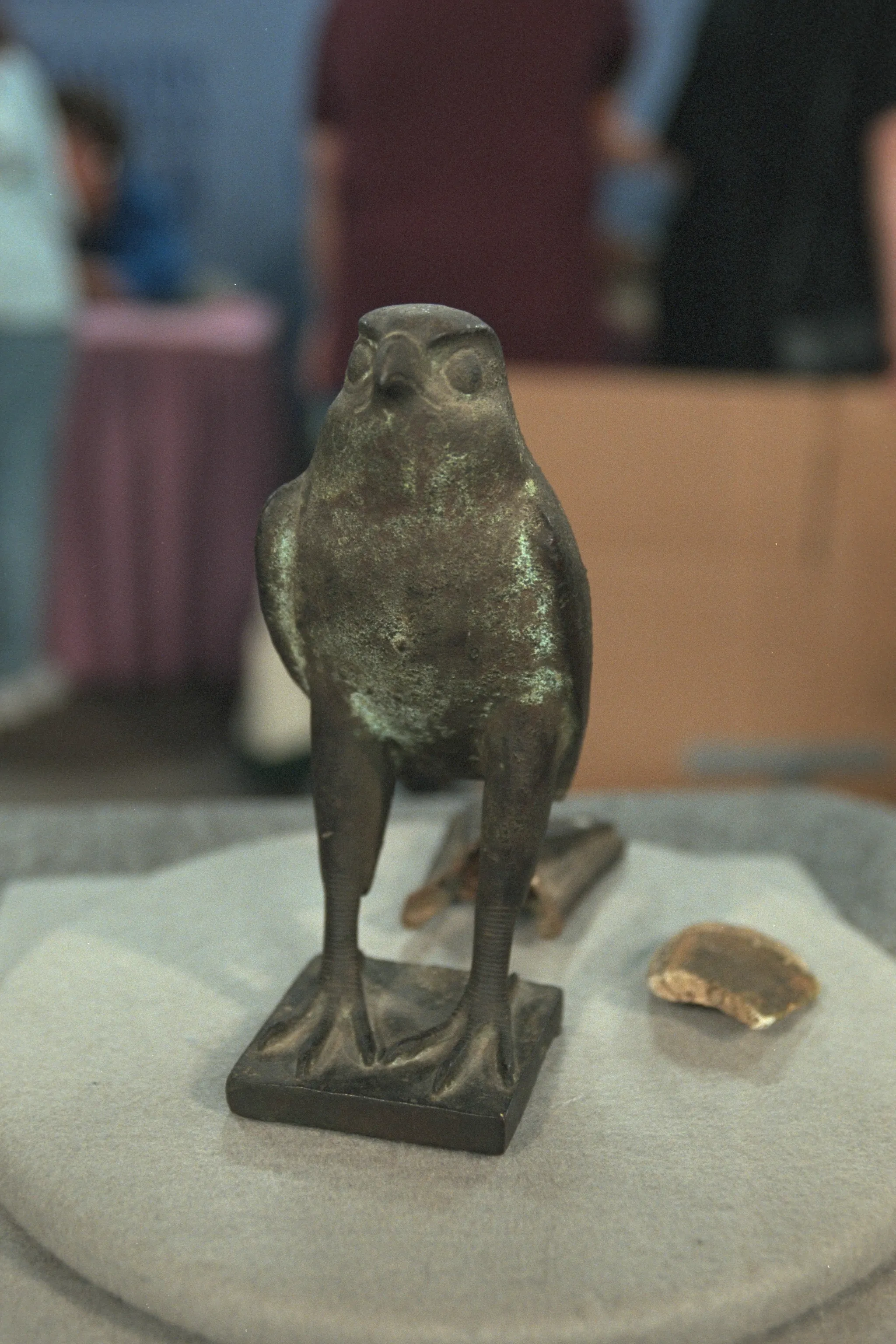
Late Period Egyptian Bronze Falcon
Understanding Our Appraisals
Executive producer Marsha Bemko shares her tips for getting the most out of ANTIQUES ROADSHOW.
Value can change: The value of an item is dependent upon many things, including the condition of the object itself, trends in the market for that kind of object, and the location where the item will be sold. These are just some of the reasons why the answer to the question "What's it worth?" is so often "It depends."
Note the date: Take note of the date the appraisal was recorded. This information appears in the upper left corner of the page, with the label "Appraised On." Values change over time according to market forces, so the current value of the item could be higher, lower, or the same as when our expert first appraised it.
Context is key: Listen carefully. Most of our experts will give appraisal values in context. For example, you'll often hear them say what an item is worth "at auction," or "retail," or "for insurance purposes" (replacement value). Retail prices are different from wholesale prices. Often an auctioneer will talk about what she knows best: the auction market. A shop owner will usually talk about what he knows best: the retail price he'd place on the object in his shop. And though there are no hard and fast rules, an object's auction price can often be half its retail value; yet for other objects, an auction price could be higher than retail. As a rule, however, retail and insurance/replacement values are about the same.
Verbal approximations: The values given by the experts on ANTIQUES ROADSHOW are considered "verbal approximations of value." Technically, an "appraisal" is a legal document, generally for insurance purposes, written by a qualified expert and paid for by the owner of the item. An appraisal usually involves an extensive amount of research to establish authenticity, provenance, composition, method of construction, and other important attributes of a particular object.
Opinion of value: As with all appraisals, the verbal approximations of value given at ROADSHOW events are our experts' opinions formed from their knowledge of antiques and collectibles, market trends, and other factors. Although our valuations are based on research and experience, opinions can, and sometimes do, vary among experts.
Appraiser affiliations: Finally, the affiliation of the appraiser may have changed since the appraisal was recorded. To see current contact information for an appraiser in the ROADSHOW Archive, click on the link below the appraiser's picture. Our Appraiser Index also contains a complete list of active ROADSHOW appraisers and their contact details and biographies.


