1781 Matthias Hornsteiner Violin
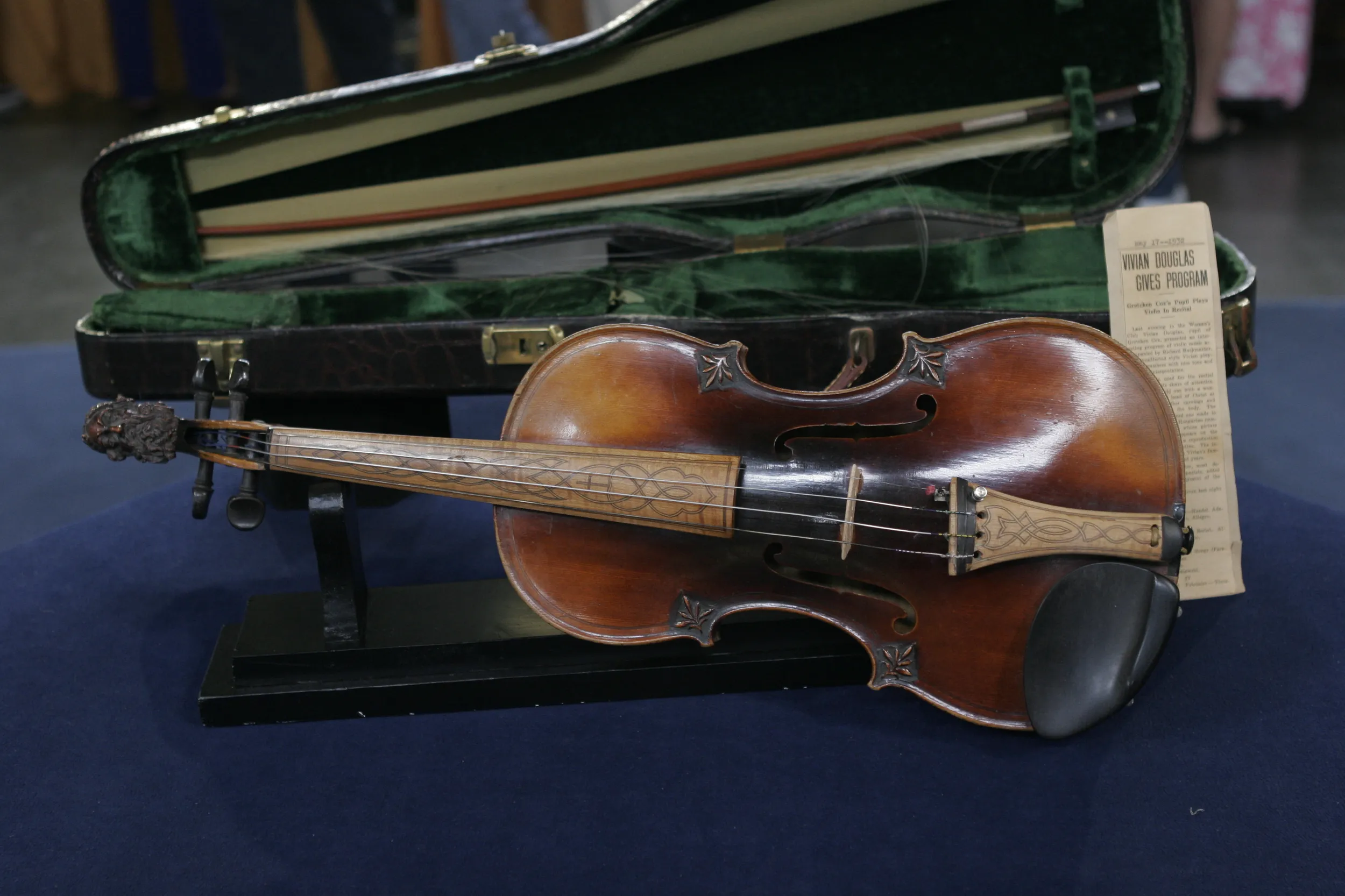
GUEST: This is a violin that's been in our family for years, decades. It was my father's. My father had a long, illustrious career in the Air Force and rose to the rank of a major general. I don't know how much he paid for it, but he would have picked it up probably in the mid-1970s during one of his tours to, to Germany. It never was repaired. We've never, obviously, tried to play it. It hung on the wall. And it's an unusual piece, and I think that's probably why it had prominence and just as a wall hanging.
APPRAISER: I think that the lion carving for the top of the peg box makes it really, really unique.
GUEST: The thing that we loved, too, was the wood. The wood on the back is a burl, which is a really unusual... It's a very pretty pattern.
APPRAISER: Indeed, it looks like it's been a beloved violin. You can tell by the creases in the finger board that the strings make as it's played, and that this has been a violin that's been played a lot.
GUEST: Uh-huh.
APPRAISER: And cherished, because it's in beautiful, very, very pure condition.
GUEST: There are a couple of labels that are inside, but they're in a language that, that I don't read. So I was hoping that, that maybe someone could decipher it. My dad collected a lot of musical instruments throughout his career. And I know that this was special to him. And, in fact, after he retired from the Air Force, he went to school and became a luthier. So he repaired stringed instruments and actually made some of his own. But this, obviously, was, was very dear to him because he hung on to it, rather than putting it up for sale.
APPRAISER: Well, I'm impressed that he became a luthier, that he became a violin maker. Because that also means he had the eye to appreciate something that was quite special. And, indeed, the wood that's on the back of the violin is maple. We call it bird's eye maple.
GUEST: Oh.
APPRAISER: And it's very typical of a particular period and making in the history of the German violin making. That helps us place it, in terms of the geography of the instrument. And, indeed, there are two labels that are on the inside. One is a repair label from H. Voigt in Vienna, and it's dated 1879. But it says "repair."
GUEST: Amazing.
APPRAISER: And the second label that's on the inside, that you probably noticed is a Latinized label, a name of Nicolò Amati, who was one of the great founders and originators of the violin in Cremona, in Northern Italy, in the 1600s to 1700s.
GUEST: Yes.
APPRAISER: And that's a false label. So those two labels don't tell us much about the origins of the instrument. But what we have found is that there is a third label.
GUEST: Oh, really?
APPRAISER: There's a third label on the inside of the violin, and it is glued to the inside of this rib on the base side. And it's upside down as, as you read it. And that tells us who made it.
GUEST: Really? Who did? (laughing): Who made it?
APPRAISER: I was so thrilled to see that label, I can't even begin to tell you. It took everything not to start jumping up and down. But it was made by Matthias Hornsteiner. The label says "Matthias Hornsteiner, Lauten- und Geigenmacher, Mittenwald, 1781."
GUEST: It's from Mittenwald, oh!
APPRAISER: So Mittenwald is in the Bavarian Alps.
GUEST: Yes, yes.
APPRAISER: It's been a center of violin making going back into the 1600s. And the Hornsteiner family were the kings. They were the earliest of the makers. Well, there were two families-- the Klotzes and the Hornsteiners. And the Hornsteiners were really highly regarded, and Mathias Hornsteiner II is considered to be the top-notch member of the Hornsteiner family. And so the violin is absolutely pure. It's got the original peg box with the lion's head on it.
GUEST: Uh-huh.
APPRAISER: Carved from pear wood. The body is in really untouched condition. And then the repair label from Mr. Voigt, he also branded the side of the neck. So you can see his stamp on the side of the neck. He must have been incredibly proud of having worked on this violin. And we believe that he changed the neck to modernize the violin in 1879.
GUEST: Oh, my father would be so thrilled if he was still alive to know this.
APPRAISER: It's, it's gorgeous, absolutely a pristine example of Matthias Hornsteiner's work from 1781.
GUEST: That's fabulous!
APPRAISER: And we would put a retail value on it of $20,000.
GUEST (laughing): Oh, my. Really? Really?
APPRAISER: That's right, and that's conservative.
GUEST: It's going to stay in the family and be a masterpiece for our family for a long time. It's just a wonderful piece-- we knew it was. We just had no idea how great it was.

$20,000 Retail
Featured In
episode
Crocker Art Museum, Hour 3
ROADSHOW is California dreamin’ with an $85K appraisal and more at the Crocker Art Museum!
19th Century
appraisal
appraisal
appraisal
Understanding Our Appraisals
Placeholder