The proof is in the dirt: There’s little doubt that water carved ancient Mars. Between 3.5 and 4 billion years ago, it ran down into valleys, forming branching rivulets that spacecraft above the Red Planet now study from orbit.
But simulations of the early Martian atmosphere don’t match the observed erosion features, a new study argues. Since it’s too cold and too low-pressure for liquid water to last on the modern Martian surface, the planet’s climate must have been different than it is today. Exactly what that early climate was like—and how exactly the water erosion happened—remains a mystery.
Scientists are narrowing the possibilities, though. The shape of the erosion features allowed study author Philip von Paris of the German Aerospace Center to estimate the amount of rain it would take to form them. The answer: a lot. “Many of the valleys would need tropical rainforest values of precipitation to make them,” von Paris says.
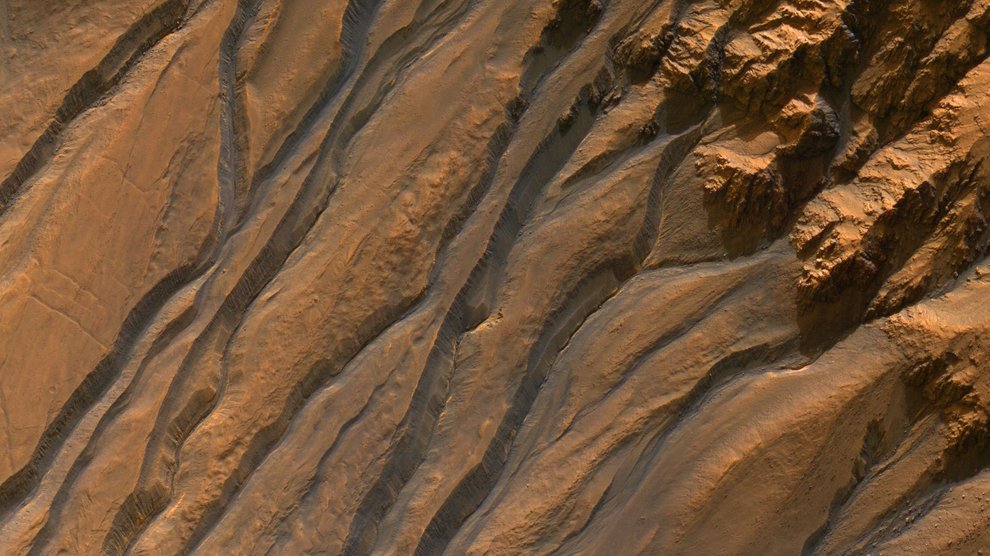
That’s a problem, because the ancient Martian atmosphere, according to his and other simulations, was freezing cold and dry. It couldn’t produce anywhere near enough rain—at least not as a global average. “The discrepancy was huge,” von Paris says. That suggests rain might not be the culprit at all.
“We tried to tried to reconcile geomorphology and climate simulations under the assumption of a continuously wet early Mars,” von Paris says of the comparison. His study is the first to quantify the two approaches together. “It doesn’t work, so that means the assumption is probably not true.”
The idea that early Mars may have been warm and wet, Earthlike even, dates back to the early 1970s. Scientists working on the Mariner 9 probe, including the young Carl Sagan seen in a NASA educational video, were stunned to see what looked like dried streambeds on some of the oldest exposed Martian terrain.


It’s difficult to test, because the ancient Martian climate isn’t something planetary scientists can observe. “It’s 3.8 billion years ago, so we didn’t have rovers then,” von Paris says. Instead, scientists have to use different approaches—climate modeling, hydrology, mineralogy—to try to understand what Mars was like from multiple angles at once.
Modern-day atmospheric modelers like von Paris and Robin Wordsworth, a planetary scientist at Harvard, have trouble in their simulations making ancient Mars warm enough for liquid water. “The current most accurate models in existence suggest that episodic, not long-term warming is the reason for early Mars’ surface erosion,” Wordsworth writes in an email.
That’s because 4 billion years ago, the Sun wasn’t as bright as it is today. And even a likely atmosphere with lots of carbon dioxide can’t conjure up enough global warming to let water linger on the planet’s surface.
The simulations lead Wordsworth, von Paris, and other climate modelers to argue that rains and rivers didn’t form the valley networks. Instead, rare events like meteorite impacts and volcanoes may have melted fallen snow on the highlands, which could then run into valleys and carve out the observed channels.
The climate modeling camp’s conclusions are far from universal, says Nicolas Mangold, a member of the Curiosity rover’s ChemCam team at the University of Nantes, France. Minerals on the Martian surface suggest water once flowed freely. “At least part of the minerals are due to weathering” from water, he writes in an email. Curiosity has also found clays that appear to have formed in a lake.
“None of these observations can be explained by a cold freezing early Mars or we should still observe the same processes in the present or recent times,” Mangold writes. “My point of view is that observations will remain, whereas models will change.”
It’s possible that both hypotheses are correct. After all, plenty could have happened on Mars four billion years. “One thing I’m fairly convinced of is that it’s probably insufficient to talk of any single, steady early climate,” Wordsworth writes.